
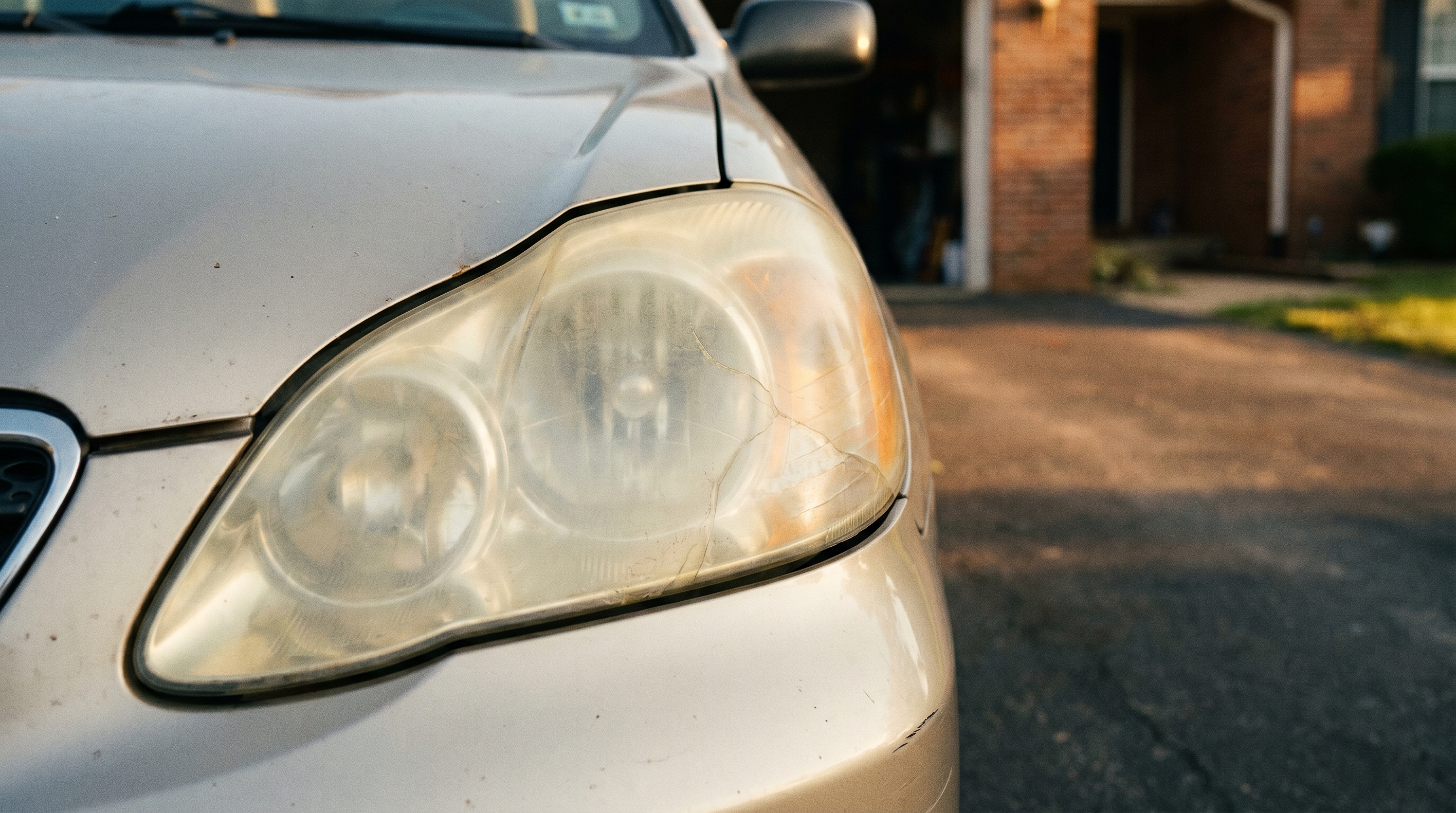
There's a specific moment most car owners notice it. Not when it happens, but months after. You're parked next to someone with a newer car, or you catch your own reflection in a garage door, and the headlights look the color of old teeth. The beam at night has felt weak for a while, but you chalked it up to the road or the weather. The lens is what changed.
Polycarbonate headlight covers are the industry standard because they're lighter and more impact-resistant than glass. The trade-off is that polycarbonate is vulnerable to UV radiation. Manufacturers apply a clear protective coating at the factory, but it degrades over two to five years of sun exposure, road debris, and temperature cycling. Once that outer layer breaks down, the lens itself begins to oxidize. The yellowing isn't cosmetic in the way a scratch is cosmetic. It's a transparency problem. A heavily oxidized lens can block 30 to 40 percent of usable light output, which matters more than most drivers realize until they're on a dark two-lane road at 65 miles per hour.
What the fix actually involves
Surface oxidation sits on the outermost microns of the lens. It's accessible, which means an abrasive compound can remove the degraded material and expose the clearer polycarbonate beneath. The important variable is what comes next. Bare polycarbonate will begin oxidizing again almost immediately without something to slow UV penetration. Any restoration that skips that step is just buying a few months before the haze returns.
The other variable worth understanding is what surface treatment can't do. Internal fogging from a cracked seal, deep structural crazing, or peeling that's worked into the base coat are not surface problems. They're replacement problems, and no liquid or pad will change that. Knowing the difference before you start saves a wasted afternoon.
For the far more common case, which is a three-to-seven year old car with uniform yellowing and mild surface haze, the repair is genuinely straightforward. Tape the surrounding paint, apply the restoration compound, follow the sequence, let the UV sealant cure. An hour, maybe less.
The kit we settled on handles the full sequence without shortcuts. The restoration liquid is formulated for polycarbonate, removes the oxidized outer layer evenly, and the UV-protective finish it leaves behind actually does the job of slowing re-oxidation rather than serving as label copy. No machine buffer required. One application covers both lenses on most vehicles, and the result is measurably cleaner light output, not just a better-looking lens in daylight.
It fits a certain kind of person well. Someone who takes reasonable care of his car, knows this has been on the list for a while, and would rather spend an hour on a Saturday than schedule a shop appointment for something he can handle himself. It also travels well as something to hand off. Practical to explain, satisfying to use, and the before-and-after is the kind of visible result that makes it feel worth the effort.
The work takes less time than the diagnosis usually does. Worth picking up before another season of UV does the deciding for you.