
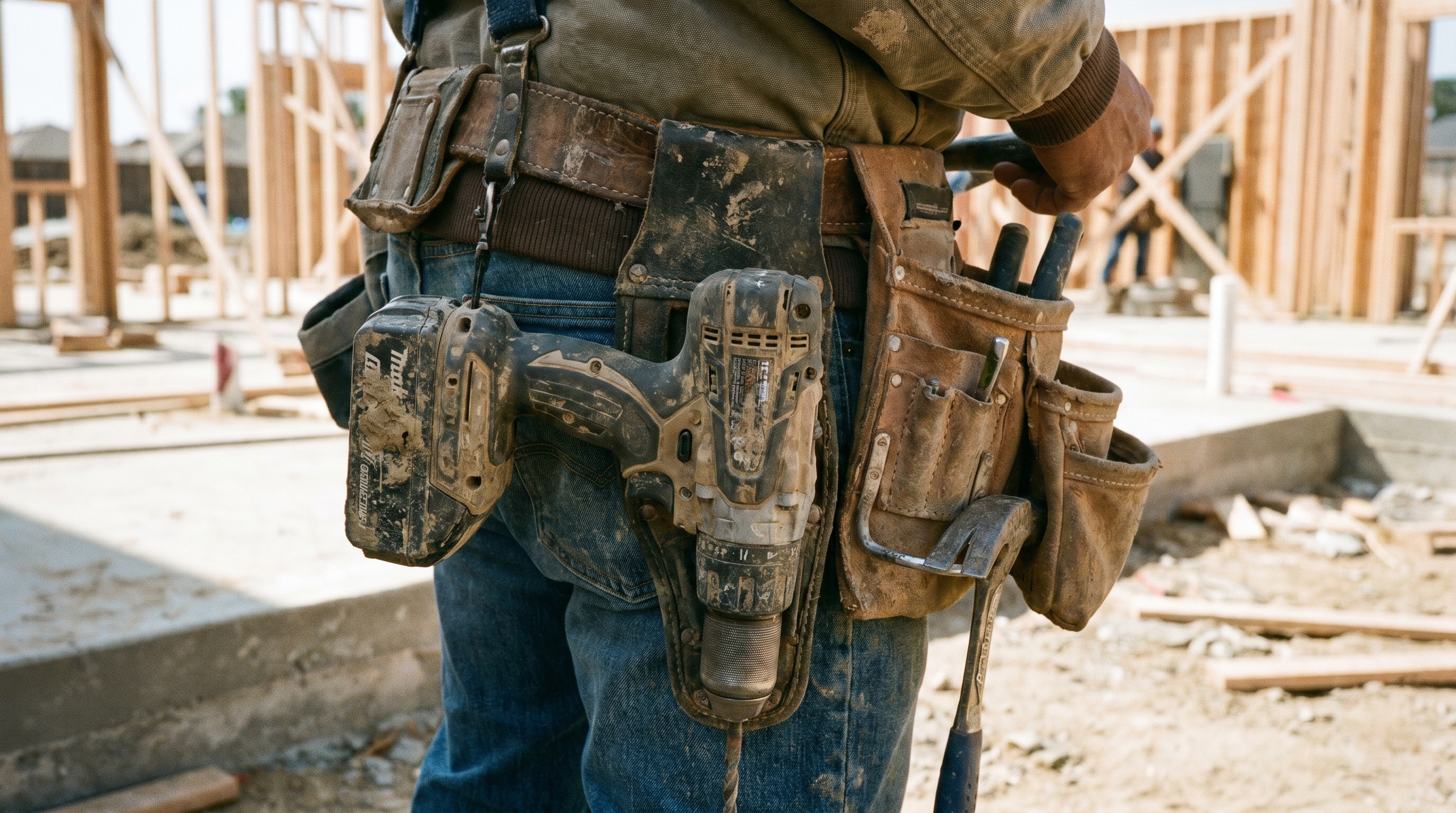
A cordless drill weighs between three and five pounds depending on the battery. That doesn't sound like much until you've picked it up and set it down sixty times before noon. The drill isn't the problem. The problem is that most people have nowhere logical to put it between uses, so it ends up on a sawhorse, a windowsill, a step of the ladder. Every one of those trips is a small tax on your attention and your pace.
Tool belts have been around long enough that you'd think the accessories would have caught up by now. Mostly they haven't. A lot of holsters on the market are sized for aesthetics rather than actual drills, built from materials that compress and sag after a few months of real use, and designed without much thought for where the weight actually lands on your body. The hip and lower back are doing a lot of work on a construction day. A holster that hangs wrong, sits too high, or pulls forward at the wrong angle adds low-grade fatigue you don't always notice until you're driving home and your back is asking questions.
Where the weight actually goes
The physics here are simple but often ignored. An angled, low-riding holster positions the center of the drill's mass closer to the hip joint rather than cantilevering it outward. Less lever arm means less compensating tension in the surrounding muscles. Over eight hours that difference is real. It's the same logic behind why well-fitted tool belts distribute weight across both hips rather than stacking it all on one side. The body is good at load-bearing when the load is balanced. It's bad at it when the load is awkward.
Reinforcement matters too, and not just for longevity. Riveted hardware and tight stitching at stress points keep the holster from deforming under weight. A holster that stretches out of shape after a few months starts to let the drill shift around, which changes where the weight sits, which changes how your hip compensates. The degradation is gradual enough that most people don't connect the cause to the effect.
The version we settled on for the shop is the ToughBuilt Heavy-Duty Drill Holster. It's designed for working jobsites, not the occasional Saturday project, and that intention shows in the details. The angled low-ride position does what the geometry promises. The reinforced stitching and rivet-strength hardware hold their shape. Multiple accessory pockets keep bits and a spare battery within reach without any rummaging. The belt-clip attachment is secure and positions cleanly, and the whole thing stays compact enough to move through tight spaces without snagging on door frames or slowing him down in a crawl space.
It's also priced the way a practical tool should be. Not inflated for a brand name, not so cheap that you're replacing it in a season.
For someone who works with his hands regularly, this is the kind of thing that earns permanent real estate on the belt and stops being something he thinks about. That's the best version of any tool accessory. The ones that disappear into the routine. He'll reach for it on the first job and every one after, which is the only endorsement that actually counts.
Worth picking up before the next project starts.