
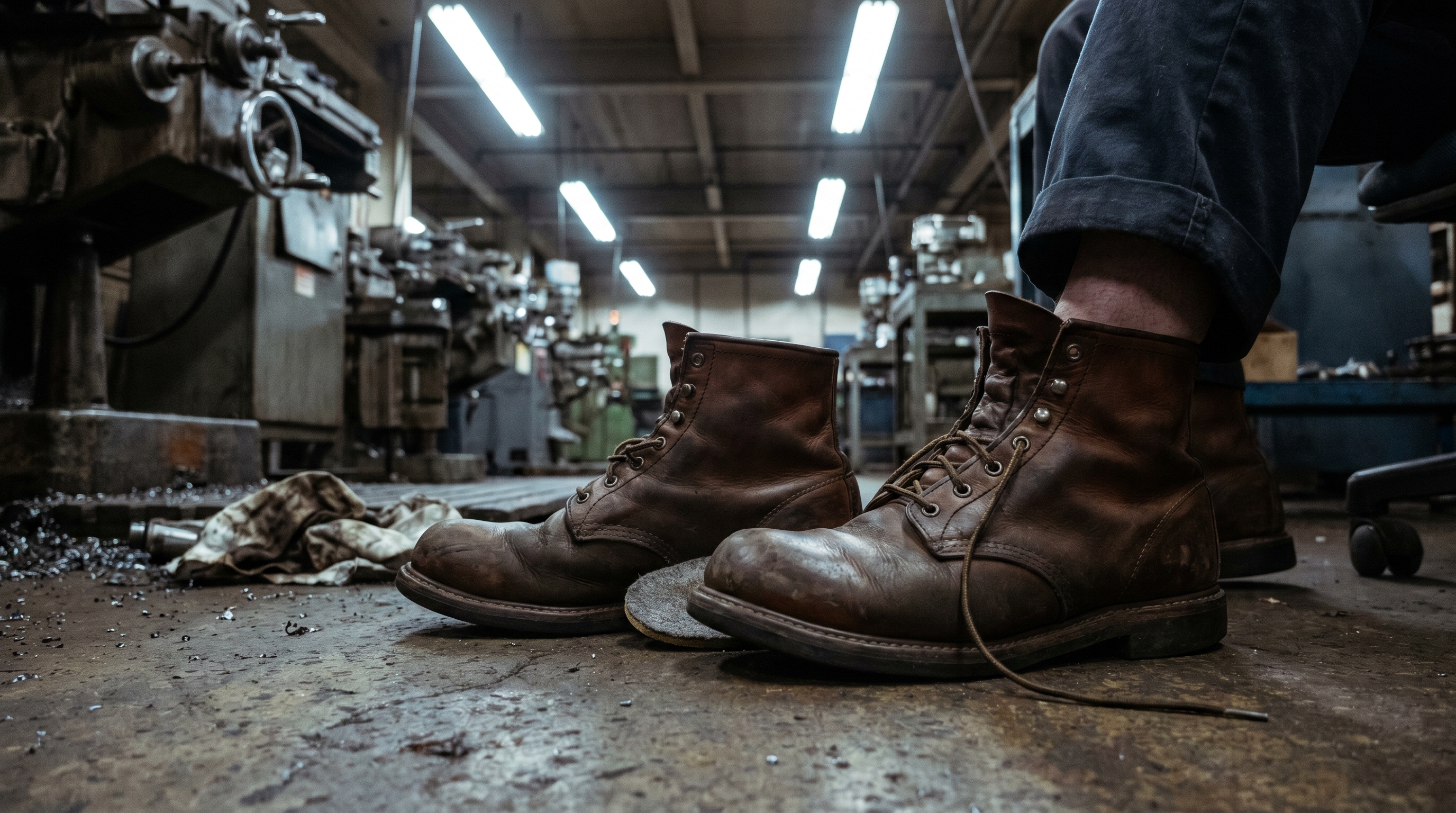
The factory insole that came with your shoes was designed to pass a quality check, not to carry you through a ten-hour day. It's a flat slab of compressed EVA foam, maybe 4mm thick, printed with a logo nobody looks at. It doesn't know anything about your arch. It doesn't adapt to your heel strike. It exists because the shoe needed something in it before it shipped.
Most men never replace it. Not because it's working, but because foot discomfort is the kind of thing you normalize gradually. The ache at the end of the day starts to feel like baseline. You chalk it up to the shoes, or the floor, or being on your feet too long. The insole sits there, blameless, while your plantar fascia quietly accumulates the load.
What padding alone doesn't solve
There's a mechanical difference between cushioning and support, and it matters more than most insole marketing acknowledges. Cushioning absorbs impact. Support distributes load. A thick foam layer does the first thing reasonably well for about an hour, then compresses and holds its compressed shape for the rest of the day. That's why shoes feel fine in the morning and wrong by 3pm.
Real arch support requires structure, something rigid enough to hold a shape under bodyweight, contoured specifically to the longitudinal arch, not approximated by a flat piece of foam. Podiatrists have known this for decades, which is why custom orthotics have always worked better than off-the-shelf cushioning inserts. The gap between those two options used to be wide. It's narrowed.
The version we settled on is the 4D Cloud Insoles, which use a 3D-printed orthotic structure underneath a memory foam top layer. The structure underneath is what does the actual work, holding the arch geometry across a full day rather than collapsing under the first hour of real use. The foam on top handles impact and conforms to the individual foot over time. Podiatrist-recommended for plantar fasciitis and heel pain, which is a credential worth noting because it's the kind of thing that gets earned through clinical feedback, not marketing copy. Trimmed to fit most shoe sizes, they move between a work boot and a trainer without drama.
Each pack includes two pairs. That detail sounds minor until you think about it practically. One set in the everyday shoes, one in the boots, no swapping required. It's the difference between a thing you actually use and a thing you forget on the shelf because it's inconvenient to rotate.
Who actually needs these
Anyone who logs real hours on his feet. That covers more ground than it sounds. Construction trades, healthcare, long airport connections, a day of errands that turns into six hours of walking. The shock-absorption layer handles hard floors and uneven terrain equally well, which makes these as useful on a jobsite as they are in a city. If he's been silently managing heel pain or mid-foot fatigue, the improvement from the first day is the kind of thing he'll actually notice and mention, which is rare for anything that goes inside a shoe.
Worth handing over.