
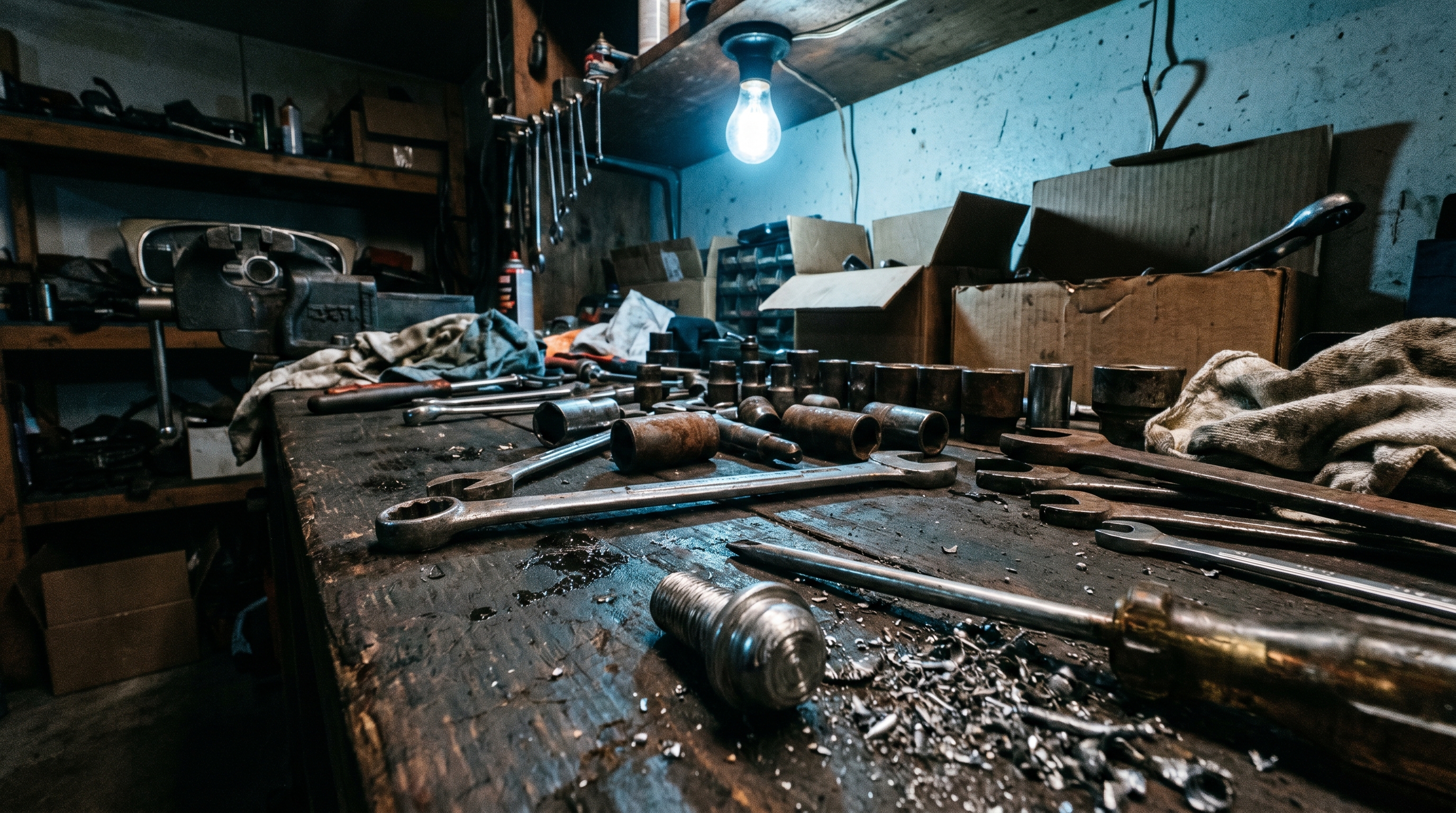
Most tool sets are purchased once and replaced twice. The first one comes from a big-box end-cap, feels promising in the parking lot, and starts rounding off fasteners by the third use. The second one is a professional-grade haul bought in frustration, costs too much, lives in a rolling chest no one opens, and still doesn't have the one adapter needed for that specific job under the sink. Neither solves the actual problem.
The actual problem is range without bulk, and organization that survives contact with a real garage.
What "impact-rated" actually means in practice
Most casual tool sets are built for hand-torque. The bits and sockets are fine for assembling flat-pack furniture or tightening a hinge, but put them under an impact driver, the kind that delivers rotational force in sharp, rapid bursts, and the metallurgy starts to matter. Standard chrome-vanadium steel at consumer tolerances will micro-crack under repeated impact loading. You won't see it. You'll just notice the socket slipping, the corners rounding, the fastener suddenly stuck in a way it wasn't before.
Impact-rated tools are built to absorb that shock. The geometry of the steel, the heat treatment, the coating, all of it is tuned for torque spikes rather than smooth rotation. Manganese phosphate coating, specifically, provides a matte surface that resists corrosion and reduces surface friction in ways that chrome plating doesn't. It's not a cosmetic choice. It's why the tool still works right after two winters in a cold garage.
The magnetic retention piece matters more than it sounds. A bolt held against a driver bit by an embedded magnet is a bolt that doesn't fall into an engine bay, doesn't roll under a car door, doesn't disappear into a wall cavity. Small efficiencies compound over a job. They're the difference between a project that takes an hour and one that takes three.
The coverage problem
Beyond materials, tool sets tend to fail on range. A kit optimized for automotive work ignores HVAC. A kit built around standard sockets skips metric entirely, which is fine until you're working on anything made after 1990 or anything made outside North America. Deep-reach sockets, the ones that get to recessed fasteners when standard depth just bottoms out, are almost always an afterthought or an omission.
The 20-piece combination wrench set covering both metric and SAE, stored in its own dedicated rack rather than jumbled loose, is the kind of inclusion that signals the set was designed by someone who has actually run out of the right wrench mid-job. Same with the magnetic pickup tool. Three pounds of pull, built for tight spaces. It exists because dropped hardware in a confined space is one of the more genuinely aggravating experiences in home repair, and nobody wants to disassemble more than they already have.
The 58-Piece Impact Tool Set we carry is the version we settled on after looking at what actually fills the gap between weekend kit and professional overkill. Cr-V steel throughout, manganese phosphate coating on the impact nut drivers, embedded industrial magnets, deep-reach sockets, a universal socket and quick-change bit extension for flexibility, and the full wrench spread in both measurement systems. The hard case has engraved size markings and dedicated compartments that hold their shape, which sounds like a small thing until you've worked from a case where everything has migrated to one corner.
It's the right set for someone who fixes things around the house with real frequency, someone stepping into their first owned home with actual systems to maintain, or someone who's been borrowing tools long enough that it's become a running joke. He'll use it the first weekend. He'll still be using it in five years.
Worth handing over.