
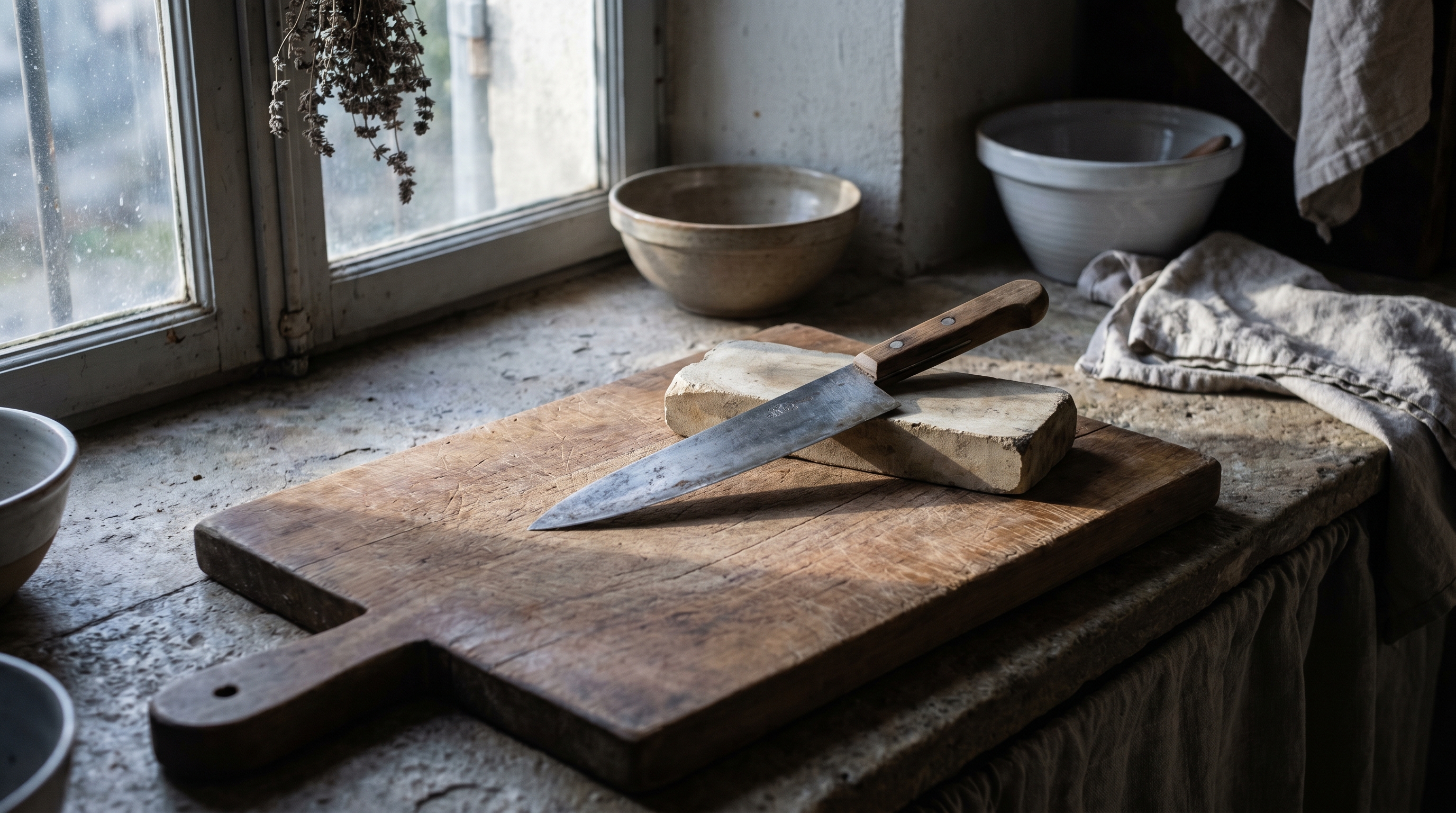
Most sharpening stones sold today are not stones. They are bonded abrasive composites, aluminium oxide or silicon carbide particles pressed into a brick shape and given names that sound geological. Novaculite. Arkansas. They look the part. They sit on the counter and perform the ritual. But the material itself is manufactured, which means it behaves like a manufactured thing: it glazes, it wears unevenly, and it eventually stops cutting the way it did on day one.
This matters more than most home cooks realise, because a stone that glazes over doesn't announce itself. Your knife still contacts the surface. The motion still happens. The edge just stops improving, and you assume the problem is technique.
What the geology actually does
Chalcedony quartz is a microcrystalline silica formed through hydrothermal deposition, meaning it built up over millions of years at the molecular level rather than being pressed together under industrial conditions. That nanocrystalline structure gives it a density and surface consistency that manufactured abrasives approximate but don't quite replicate. More importantly, the surface is self-renewing. As the top layer works, it refreshes rather than compacts. The stone you're using in year three performs the same as the stone you opened on day one.
At 800 grit, it occupies exactly the right position for regular edge maintenance. Coarse enough to re-establish a refined edge on a knife that's been in rotation, fine enough not to remove more steel than necessary. This is not a stone for repairing a chipped blade or re-profiling a bevel from scratch. It's a stone for keeping good knives performing like good knives, which is the job most people actually need done most of the time.
It works across kitchen knives, pocket knives, chef's blades, and flat-bevel woodworking tools. The surface is flat, white, and unbranded. No printing on the stone face, nothing to wear off or look cluttered. It sits on a counter without looking like hardware.
The non-slip rubber mat that comes with it is worth mentioning plainly: sharpening is one of those tasks where the moment the surface shifts underfoot, the angle changes and the whole session is wasted. The mat solves that without ceremony.
We settled on the White Chalcedony Sharpening Stone because it's the rare case where the material is the argument. There's no feature list that needs unpacking, no proprietary coating to explain. A real stone, 800 grit, made from something the earth produced rather than a factory. It earns its place in the kit by performing consistently every time he picks it up, and it will still be performing that way in a decade.
For someone who cooks seriously and sharpens his own blades, this is the kind of tool that quietly improves everything downstream. Better edges mean better prep, less force, less fatigue. He'll sharpen every few weeks, notice his knives feel different, and not necessarily trace it back to the stone. That's a compliment. The best tools recede into the background.
Worth putting in the kitchen drawer of someone who actually uses his knives.