
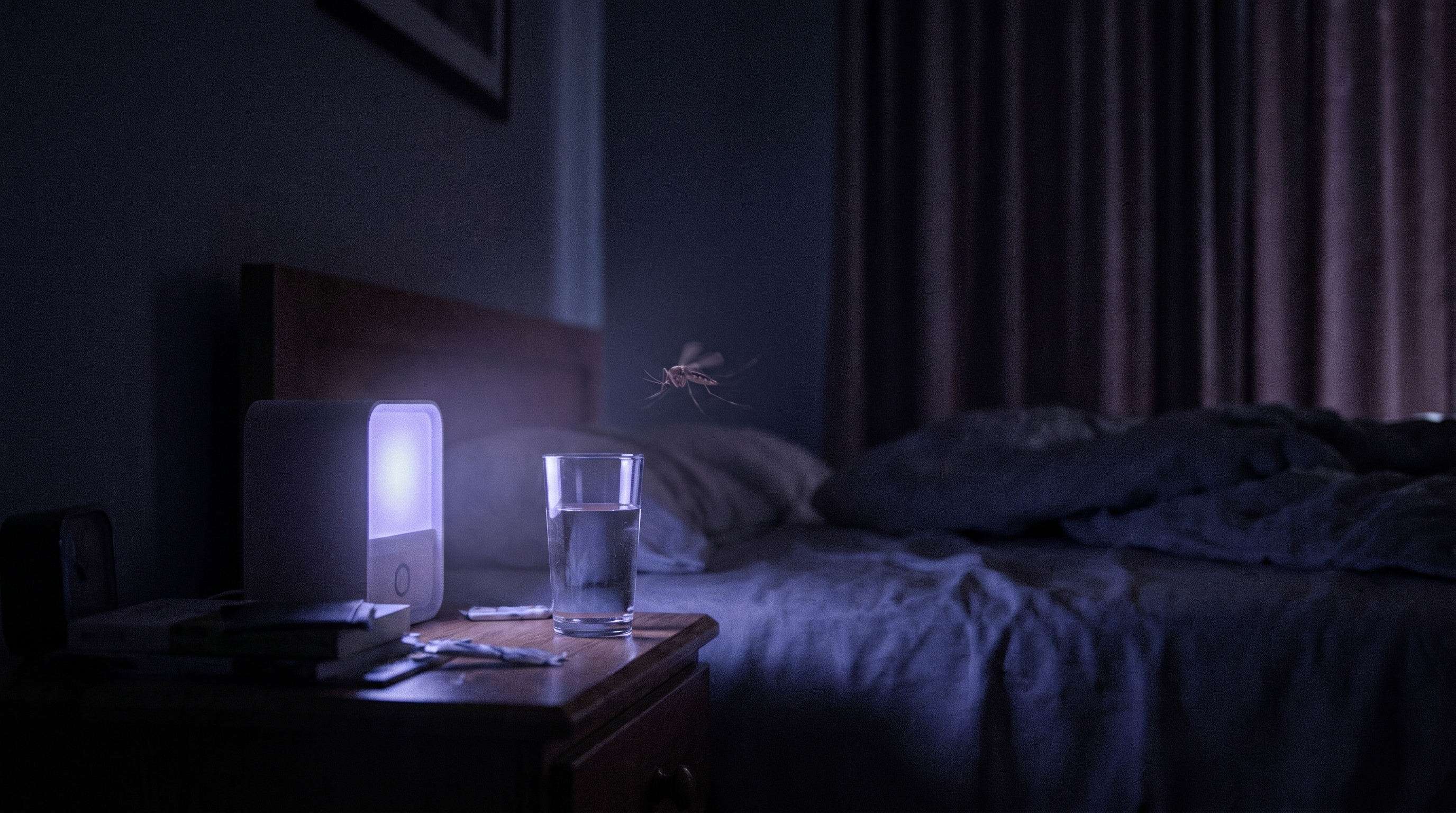
The zapper was invented in 1932. It worked on a simple premise: lure insects with UV light, electrocute them on a wire grid, and let the crackle confirm a job done. For a barn or a back porch, that's a reasonable bargain. For a bedroom, a kitchen counter, or a home office in summer, it's just trading one problem for three others.
The noise is the obvious one. But the splatter is worse. Bug zappers fragment their targets, scattering insect debris across whatever surface sits beneath them. Studies on outdoor models have found that the particles can spread up to two meters. That detail doesn't appear on any packaging.
What the ultraviolet light is actually doing
UV-based traps work because most flying insects navigate by light. Mosquitoes and moths in particular orient toward shorter wavelengths, which is why a soft UV source at close range is enough to redirect them. The light doesn't need to be harsh or broad to be effective. A low-output UV bulb in a compact housing draws them in just as well as a floodlit grid, without illuminating the hallway at midnight.
The difference between a zapper and a fan-based trap is what happens after the lure works. Instead of an electrified grid, a quiet internal fan creates a downdraft that pulls insects into a sealed chamber. They don't leave. Nothing cracks. Nothing marks the wall. In the morning, the mess that doesn't exist doesn't need cleaning up.
This matters more than it sounds. The rooms where insects are most disruptive are also the rooms where a traditional zapper is most intolerable: the bedroom where a mosquito finds you at 2am, the kitchen where fruit flies orbit the bowl, the office where gnats drift in through a cracked sliding door on a warm evening. Those are not outdoor-porch situations. They need a different tool.
The version we settled on is the Silent UV Insect Trap. Matte black housing, compact enough to sit on a nightstand or the corner of a desk without reading as a piece of hardware. It plugs in, runs without a sound, and does its work without asking for attention. No sprays, no cartridges, no refills to track down. The UV element does the drawing, the fan does the catching, and the sealed chamber handles everything after that. He'll stop noticing it's there within a day, which is the right outcome for something that exists to solve a background problem.
It earns its place anywhere flying insects make themselves known: near a fruit bowl, beside indoor plants, on a counter close to the sink, or in any room with a window or door that gets left open past dusk. Practical for a single room, easy to move if the problem shifts.
Worth placing on the counter before summer gets settled in.