
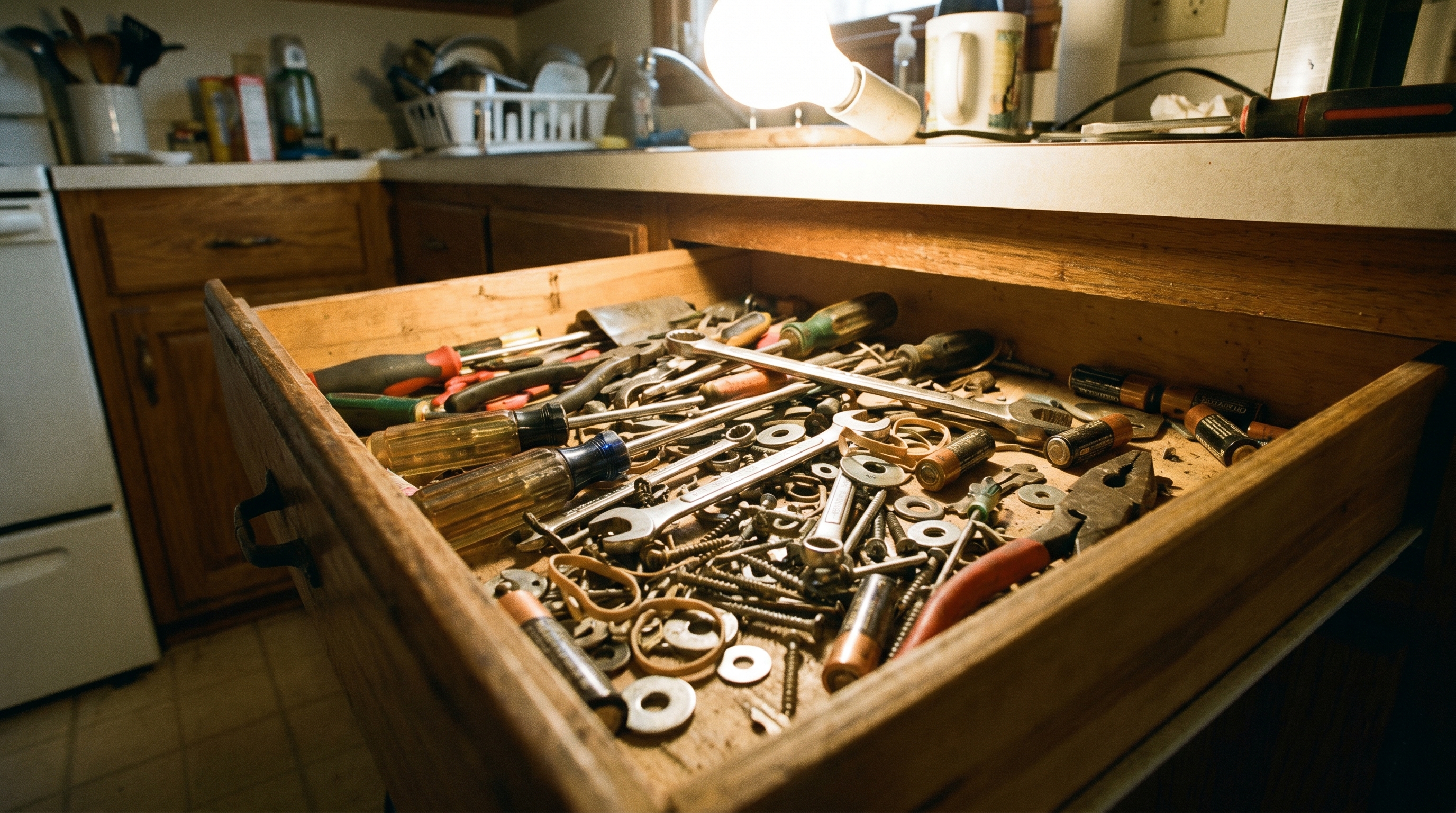
The average junk drawer contains one flat-head, one Phillips, possibly a third with a stripped handle, and a low-grade sense of guilt about never fixing the cabinet hinge. None of them get used unless the situation is truly desperate. And when they do get used, the job takes three times longer than it should because the angle is wrong, the light is bad, and at some point you're basically lying on the floor applying torque with your wrist at a geometry that shouldn't exist.
This is not a tools problem. It is a design problem.
Fixed heads, awkward spaces, and twenty minutes of unnecessary frustration
The fixed-head screwdriver has been the standard for so long that nobody questions it. But a fixed head assumes you have clear, perpendicular access to every fastener you'll ever encounter. You don't. Cabinet hardware is set back behind a face frame. Flat-pack furniture requires getting into corners that were clearly designed by someone who has never assembled flat-pack furniture. The screw is almost never exactly where you need it to be.
Cordless drivers improved the torque problem but mostly left the geometry problem alone. You traded wrist fatigue for a bulkier tool that still couldn't get into the same tight spots. The pivot head, as a concept, is obvious in retrospect. It just took a while to show up in something that didn't feel like a prototype.
The Twist 2.0 Pivot Driver locks its head at three angles: straight at 0 degrees, a moderate cant at 22.5, and a sharper offset at 45. That last setting alone handles most of the situations that would otherwise send a reasonable person back to the junk drawer to find something longer, or thinner, or just to give up and leave the hinge loose. Three torque settings let him match the force to the material, which matters more than it sounds when the difference between tight and stripped is about a quarter-turn of overconfidence.
The rest of the spec list reads like someone actually thought about daily use rather than a feature checklist. The forward and reverse trigger sits where your finger lands naturally, not where an ergonomics diagram suggests it should. An integrated LED lights the work surface when the ambient light is against you, which, in the spaces where most screws live, it usually is. USB-C charging means the cable is already on his desk. No AA batteries, no proprietary dock, no separate charger to lose.
We settled on the Twist 2.0 as the pick here because it's compact enough to live somewhere accessible instead of buried, specific enough to actually solve the problem it promises to solve, and considered enough in its details that it doesn't feel like a compromise. It ships with a two-piece bit set for immediate use, and the build has the kind of weight and finish that makes you trust it before you've even driven the first screw.
The person who gets the most out of it is the one who owns a home, rents an apartment, or simply exists in a space that occasionally demands a small repair and currently handles that demand with a drawer full of resignation. He might not describe himself as someone who "does tools," which is exactly the point. This one doesn't require the identity. It just works.
Worth keeping around. Worth handing over.