
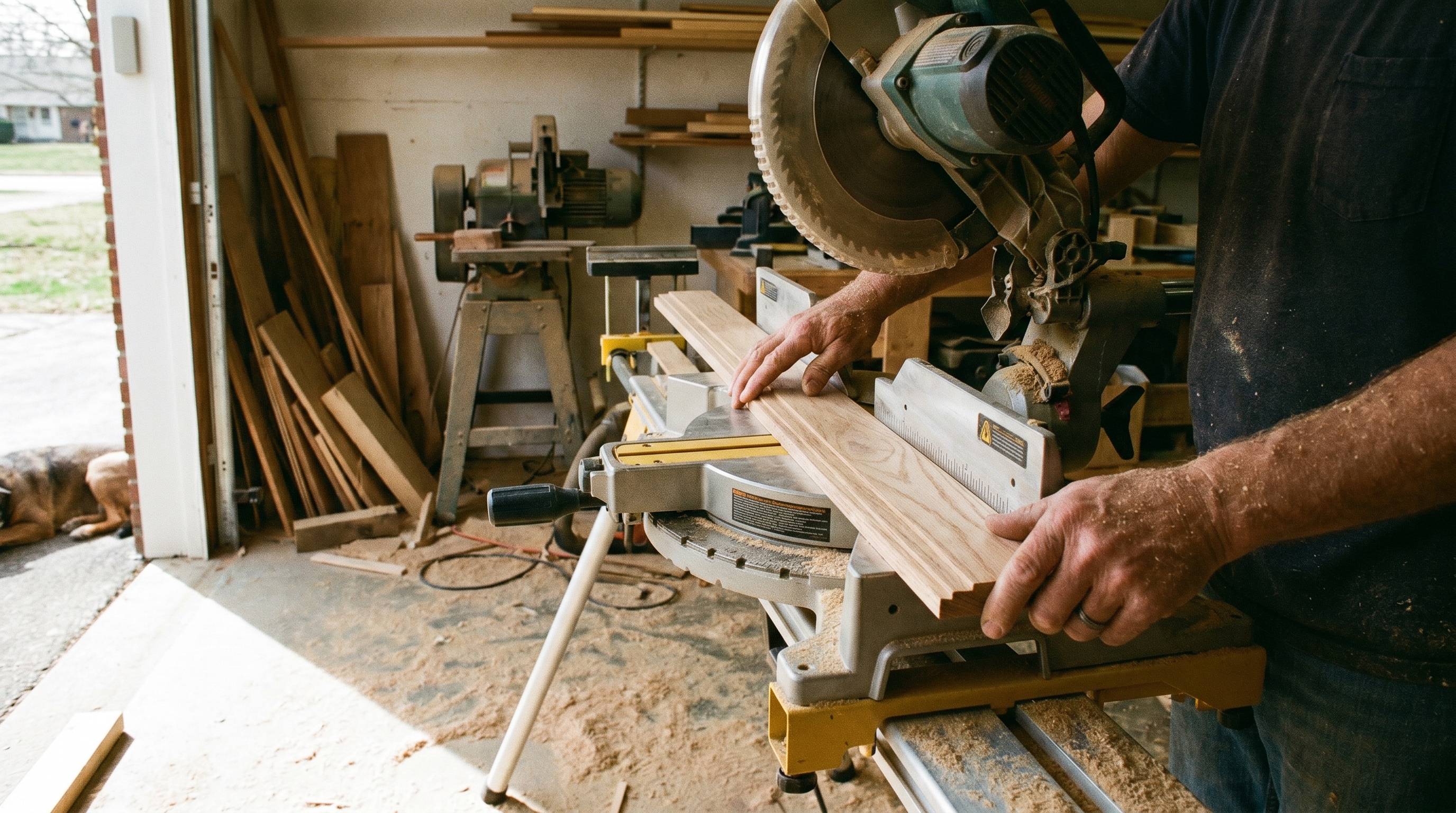
Most miter saws are oversold on horsepower and undersold on the thing that actually ruins a cut: not knowing exactly where the blade is going to land.
A capable motor is a baseline. Fifteen amps and 5,000 RPM will move through hardwood and framing stock without bogging down. Fine. That's expected. What separates a saw you trust from one you tolerate is the moment just before the blade drops, when you're lining up the cut and either you know or you're guessing. Most saws make you guess. The kerf indicator is stamped onto a fence that shifts over time. The sight line depends on the light in the room. You cut, you measure, you trim a hair, you move on. Every time.
That compounding imprecision is where projects go sideways. Crown molding that almost meets at the corner. Trim that fits on a dry run and gaps after install. None of it is catastrophic. All of it is fixable. None of it needed to happen.
The alignment problem, solved at the source
The Xact Cut shadow line system works by projecting a blade-position guide directly onto the workpiece surface. Not a laser that drifts when the saw heats up. Not a pencil mark you're approximating against. A clear, consistent shadow that shows you where the cut will fall before it falls. It sounds like a small thing. It changes the rhythm of every cut you make.
The rest of the precision end is dialed in the same way. The miter scale runs 0 to 52 degrees left and right. The bevel adjusts from 0 to 45 degrees left, with positive stops at the angles that actually come up repeatedly, so there's no hunting and re-hunting for the same setting across a long session. The vise clamping system holds the workpiece against the fence during the cut, which matters more than most spec sheets let on. A piece that moves mid-cut doesn't just ruin the board. It sets the wrong dimension in your head for every cut that follows.
We settled on the Single Bevel Miter Saw because it resolves the alignment problem without asking you to pay for features that belong on a cabinet shop floor. The 10-inch blade handles what most projects actually throw at it. At 24 pounds, it moves from the workshop to a job site or a spare room without a dedicated cart or a second set of hands. The included kit (40T TCT blade, dust bag, vise assembly, hex wrench) means it's cutting on day one, not after a parts order. Metabo HPT backs it with a five-year warranty. Japanese-engineered, built to outlast the project it came in for.
For someone who works with his hands regularly, this is the kind of tool that stops being a variable in the equation. You stop wondering whether the saw is accurate. You start trusting the number. That shift is hard to quantify and immediately obvious once it happens. For someone getting back into a shop project after a long gap, it removes the relearning curve that comes with a saw that requires calibration rituals before every session.
The one we'd reach for first.