
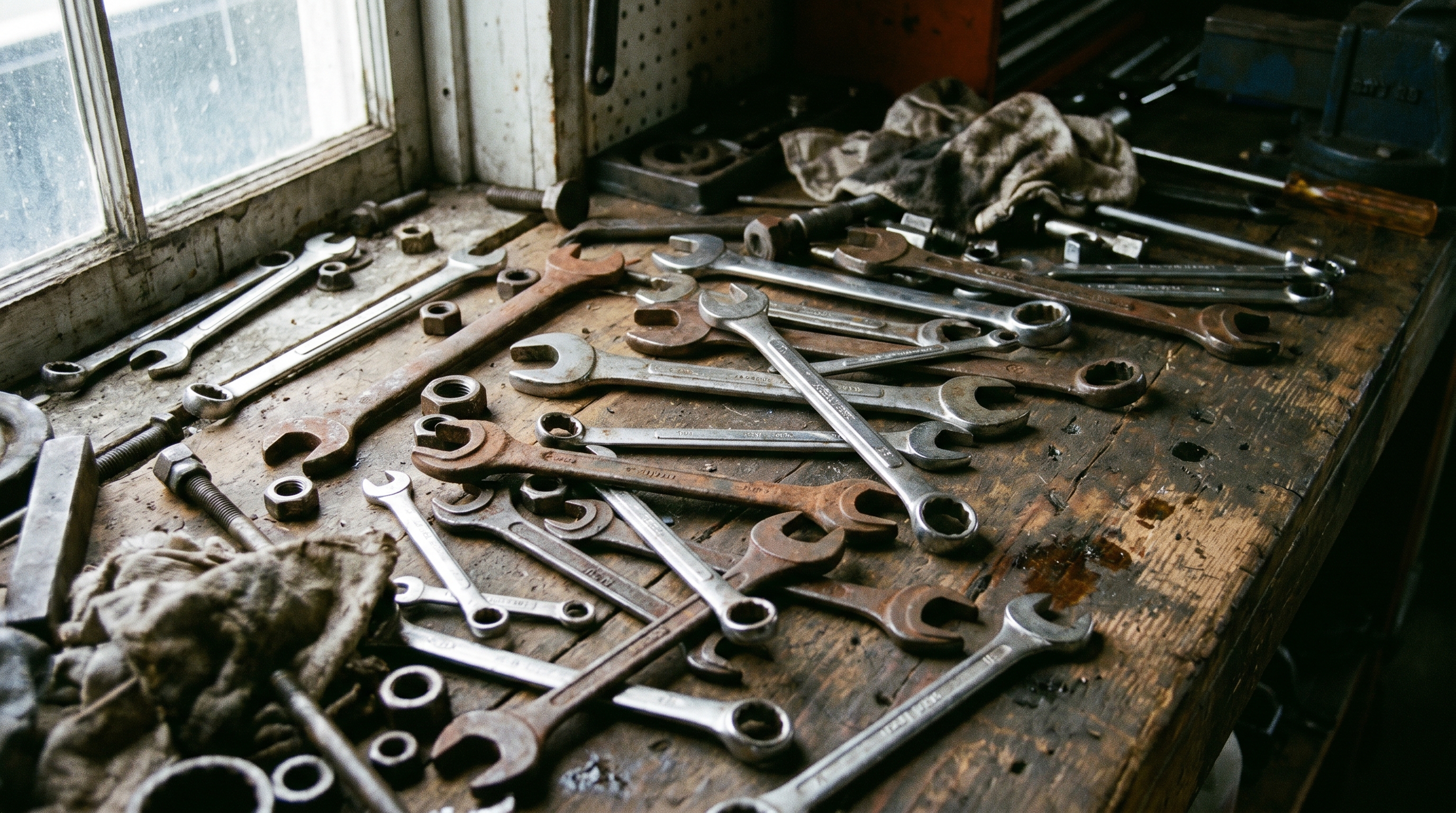
The average home garage holds somewhere between four and nine wrenches. Not a set. A collection of survivors from old kits, hand-me-downs, and impulse buys at hardware stores where the packaging made a bold promise. Half of them are SAE. The other half are metric. Two are duplicates of a size nobody needs twice. And when something actually has to come apart, there's a twenty-minute search for the one that fits.
This is not a minor inconvenience. A wrench that slips because it's the wrong size, or the nearest approximation of the right size, rounds bolt heads. Rounded bolt heads become a whole separate problem. The cost of a mismatched tool collection isn't the tools themselves; it's the damage they cause and the time they waste at exactly the moment you can least afford it.
What makes a wrench worth keeping
The material isn't a detail. Carbon steel holds its shape under torque in a way that cheaper alloys quietly don't, which matters most when the bolt is already stubborn and you're putting real force on the handle. The finish matters too, not for aesthetics but for legibility. Size markings that wear off after a season of use are markings that eventually cause mistakes.
The geometry of the ends does specific work. A 12-point box end gives more contact surface on a fastener than a 6-point, which distributes force more evenly and reduces the chance of slipping under load. The 15-degree angle on the open end sounds like a small thing until you're working in an engine bay or behind a cabinet panel, repositioning your arm on every other turn to clear an obstruction. That angle buys you clearance without needing to switch tools.
Both SAE and metric sizing in the same kit is worth more than it sounds. A lot of household hardware is SAE. Most automotive work, especially anything made in the last thirty years, runs metric. Keeping both on hand means the right wrench is a reach away, not a trip to the store.
The version we settled on
The set we carry comes in 30, 32, or 44 pieces depending on how complete a kit he's building. The 30-piece set uses a swing-type adjustable mechanism; the 32 and 44-piece sets are fixed wrenches, which is worth knowing before choosing. Fixed wrenches are generally preferred for repetitive or high-torque work where you want zero play in the head. Coverage runs from 7mm up to 22mm, which handles the overwhelming majority of home maintenance and automotive jobs without reaching for a specialty tool.
The roll-up pouch is the part that changes how the kit actually gets used. Sizes stay sorted, the whole thing rolls flat into a drawer or drops into a bag, and there's no archaeology required when something needs tightening at an inconvenient hour. It sounds like a minor organizational win. In practice, a tool you can find in under ten seconds gets used. One you have to hunt for gets substituted, and substitution is where bolt heads get ruined.
For the person who already owns most of what a garage needs, this is the set that retires the mismatched collection he's been tolerating without quite getting around to replacing. For anyone starting a real toolkit from scratch, it's a foundation that won't need revisiting.
Worth handing over.