
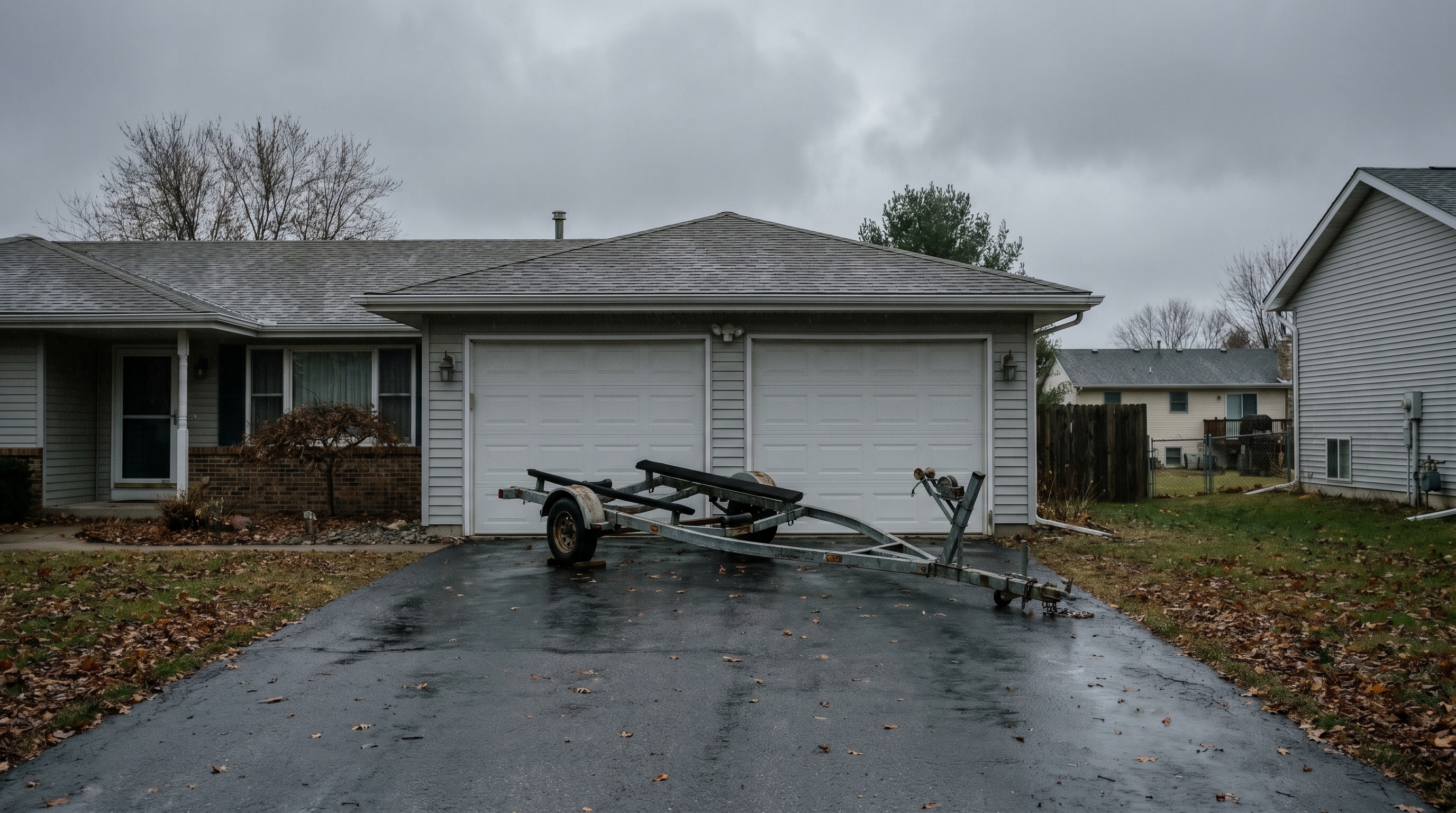
Most trailer problems aren't mechanical. They're spatial. The boat is two feet too far left. The utility trailer is blocking the third bay. The camper is parked at an angle that made sense in October and makes no sense now. None of these are big problems, but all of them feel bigger than they should be because the conventional solution, backing a truck into a tight driveway and threading a hitch ball under a coupler by feel, is a production. It takes longer than it should. Someone ends up standing in the cold giving hand signals.
A trailer dolly exists precisely because most of these moves are short. Ten feet. Thirty feet. Enough to clear a space, square something up, or get access to what's behind it. That's a hand-tool job, not a vehicle job.
Why most guys don't own one yet
The short answer is that plastic-wheeled dollies have given the category a bad reputation. They work on flat concrete, once, before the wheel develops a flat spot or the frame flexes on anything uneven. Grass swallows them. Gravel defeats them. And so the guy who tried one years ago just goes back to unhooking, moving the truck, re-hitching, and writing the whole thing off as part of owning a trailer.
The difference between a bad dolly and a useful one comes down almost entirely to the tire. An 8.5-inch pneumatic rubber tire behaves like a real tire. It compresses over a root, rolls through gravel without stalling, and holds its shape over time. That's not a feature to gloss over. It's the feature. Everything else, the frame, the coupler fit, the height adjustment, only matters if the wheel can actually move on the surface you're working on.
The frame matters too, though. Carbon steel with a powder-coat finish means it lives in the garage, sits through seasons, and doesn't turn into a rust problem. The adjustable height (16.5 or 22 inches) means it fits the hitch where it actually is rather than requiring the trailer to be leveled first. Compatibility with both 1-7/8-inch and 2-inch ball couplers covers the overwhelming majority of light trailers and boats without an adapter conversation.
The Manual Trailer Dolly we carry is the version that earns that description without asterisks. 300 lbs of tongue weight capacity, pneumatic tire, two height settings, powder-coated carbon steel, and it folds flat when the job is done. Fits in a corner of the garage or the side of a truck bed. It's the kind of tool that has no impressive shelf presence but shows its value the moment someone watches it work.
For the guy who owns a boat, a utility trailer, or a camper and parks in anything other than a perfectly flat, perfectly wide concrete lot, this is the gap it fills. He'll use it a handful of times a year. Each of those times, it will save twenty minutes and a small amount of frustration, which adds up faster than it sounds.
Worth having in the garage before the next time the trailer is in the wrong spot.