
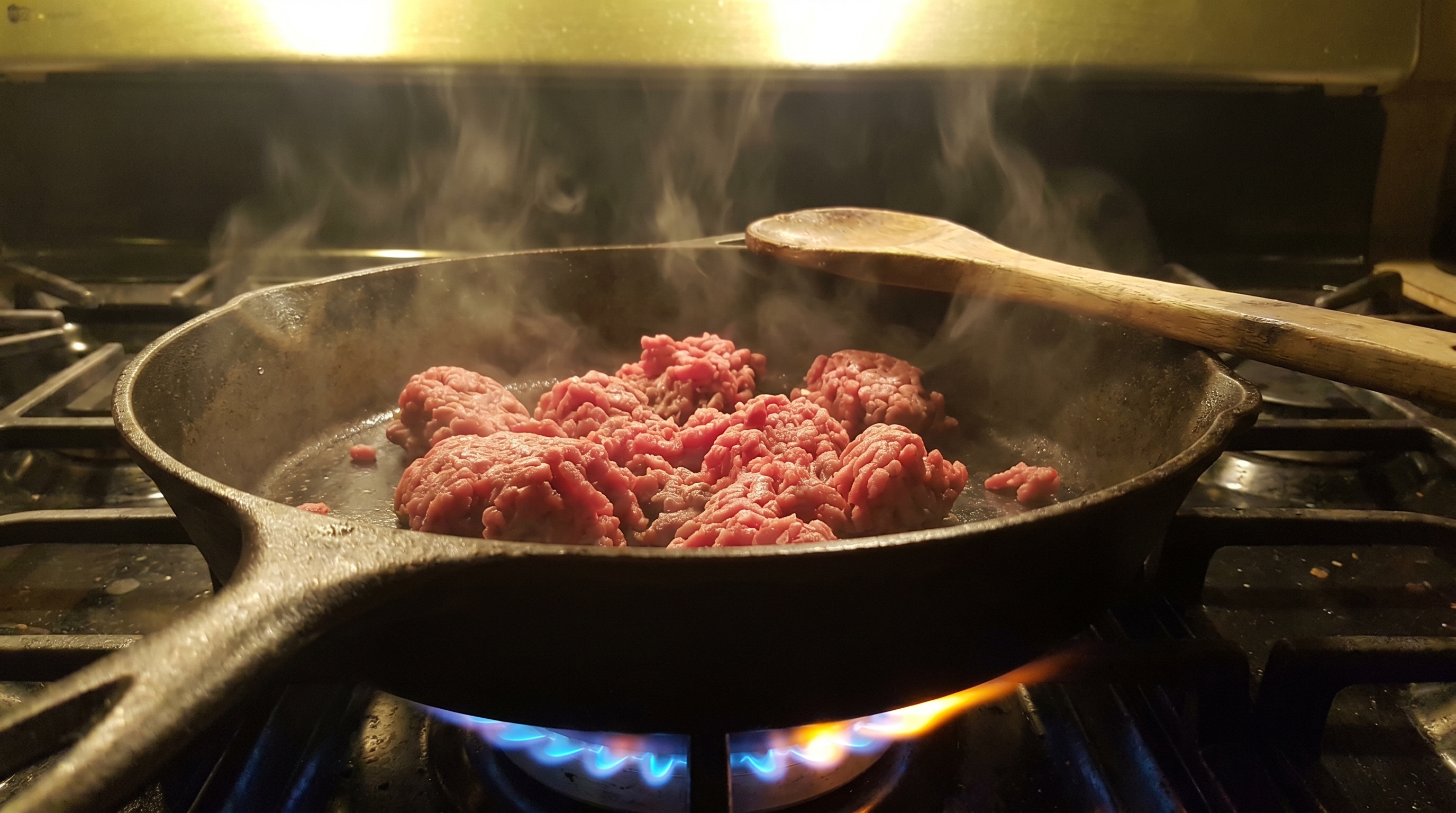
Ground beef lies. It goes into the pan looking manageable, and within sixty seconds it's a grey, steaming lump that a wooden spoon is completely unqualified to deal with. You end up pressing, dragging, pressing again. The meat breaks unevenly. Some of it overcooks at the edges while the center is still pink and stuck together. The whole thing takes longer than it should, and you're leaning over a hot pan with a tool designed for stirring soup.
This is the part of cooking nobody improves because it feels too minor to fix. But if you make tacos, bolognese, turkey chili, or anything that starts with a pound of ground protein in a skillet, you're doing this a few times a week. The inefficiency adds up.
Why a spoon is the wrong geometry entirely
A single flat edge against a mass of meat is always going to lose. You get leverage in one direction, which means you're mashing rather than cutting, and the clumps just move around. A spatula is marginally better but still asks you to work in one plane. What the job actually needs is something that distributes force across multiple points simultaneously, the way you'd use a pastry cutter through butter, except faster and over heat.
Six blades change the physics of it. Each pass through the pan covers more surface area, contacts more of the meat at once, and the gaps between the blades let the broken pieces fall through rather than compact back together. The result is a fine, even crumble in roughly half the time. Not a marginal improvement. Half the time.
The other thing that matters is build quality, because this tool is going under real pressure against a cast iron or stainless pan, sometimes with force. Cheap blade assemblies flex and spread. They also rust at the joints if the steel isn't food-grade. 304 stainless steel is the specification used in commercial kitchen equipment: non-reactive, rust-resistant, and stable at cooking temperatures. A wooden handle that doesn't flex matters too. Eleven inches keeps your knuckles off the pan edge, which sounds obvious until you've burned yourself reaching over a skillet with a short-handled tool.
We settled on this particular 6-Blade Meat Chopper because it covers both ends of that equation without asking you to pay a premium for something that should have been standard. The blade assembly is 304 stainless. The handle is solid wood and feels like it belongs in a real kitchen, not a blister pack. It also pulls duty as a potato masher and a vegetable smasher when needed, which is genuinely useful when drawer space is already a negotiation.
For anyone who cooks with regularity, it becomes one of those tools that earns its spot without requiring any explanation. He'll reach for it without thinking, which is the best thing a kitchen tool can do. It's the right thing to drop into a housewarming basket, or to hand to someone who just moved into their first place with a stove and ambitions.
One tool. A few jobs. Nothing to explain.