
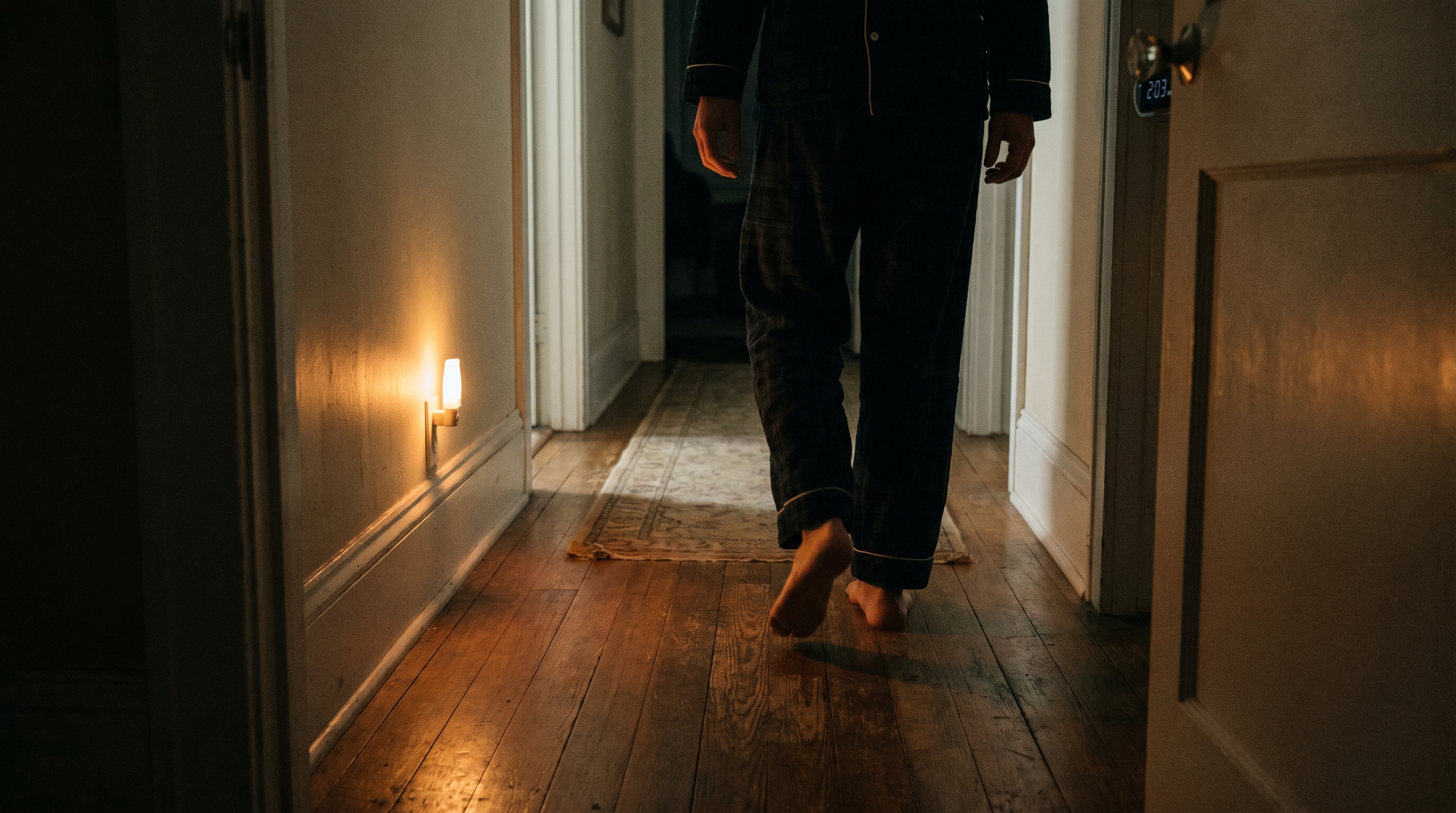
Most homes are lit for daytime living. Every fixture, every lamp, every dimmer switch is calibrated for hours when you're already awake and oriented. The dark hours get handled by instinct: the shuffle-and-reach for a switch you've memorized, the squint against a bathroom bulb that suddenly feels like stadium lighting, the attempt to move quietly through a room you can barely see.
You adjust. You stop noticing. That's how small inconveniences survive for years.
What bad lighting actually costs you at night
There's a physiological reason that bright light at 2am feels wrong. Your eyes adapt to darkness over roughly twenty minutes, building up rhodopsin in the rod cells to function in low light. A conventional light switch detonates that adaptation in about a second. You lose your night vision, your brain interprets the brightness as a signal to wake up further, and getting back to sleep costs you time and quality.
The fix isn't darkness. It's the right kind of light at the right moment. Around 3200K, warm amber tones sit far enough from the blue spectrum that they don't spike cortisol the way cooler whites do. Soft, directional, and motion-triggered: enough to navigate, not enough to announce that you're awake.
The other piece people underestimate is the range calculation. A hallway is roughly two to three meters from wall to wall. A path from bed to bathroom might be four or five steps. You need a sensor that sees the space before you reach it, not one that trips when you're already standing on it. That geometry matters more than the lumen count.
The version we settled on is the Motion Sensor Night Light. It activates on movement, reads a three-meter radius at a 120-degree arc, and cuts out thirty seconds after you've cleared the room. The 3200K output is warm enough that it won't pull you out of that half-asleep state you're trying to preserve. A built-in ambient light sensor keeps it completely dormant during the day, so the battery goes entirely toward the hours it's actually needed.
Installation is magnetic with an adhesive backing pad. No drilling, no wiring, no tools. Stick it to the wall, the inside of a closet, the side of a nightstand. When it needs a charge, it pulls off, charges via USB, goes back. The whole setup takes under two minutes, and that's about the last time you'll think about it.
It's the kind of object that works best when it disappears into routine. He sticks it up, it does its job, and three weeks later he notices it only because he hasn't stubbed his toe in a while. Good for a bedroom hallway, a bathroom corridor, the stretch between the kitchen and anywhere else. Good for anyone who's quietly accepted that navigating their own home in the dark is just something they do now.
Worth setting up tonight.