
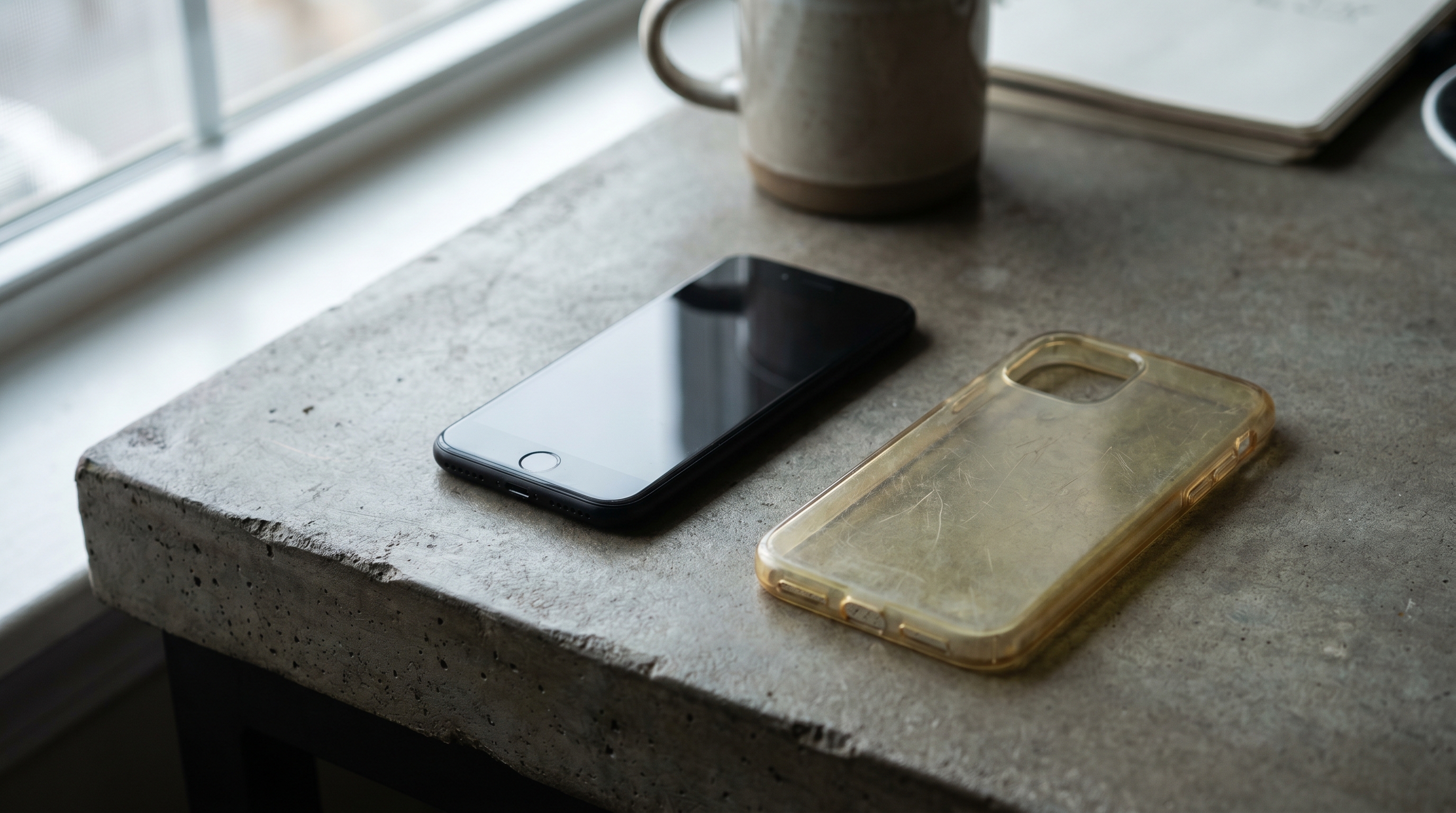
Most clear phone cases turn amber within six months. Not cracked, not scratched, just that warm, tea-stained tint that sets in slowly enough that you stop noticing it until someone else picks up your phone. The anti-yellowing problem is older than the smartphone itself, rooted in how UV light degrades standard polycarbonate resins over time. The case technically still works. It just looks like it's been stored in a drawer since 2019.
That's the first problem with the clear case category. The second is that "clear" has become a shorthand for "cheap." The form factor attracts low-margin commodity production, which means most of what fills that shelf, physical or digital, is a thin shell with no real structure, no integrated features, and no coating that lasts past a season. You buy it to show off the phone. Three months later you're showing off a beige phone.
What a case is actually supposed to do
Protection is table stakes. Scratch resistance shouldn't be the headline, it should be the floor. Beyond that, a well-designed case earns its place by integrating cleanly with how the phone actually gets used. MagSafe is the obvious example. A ring that's bolted on top of a generic case, misaligned by a millimeter or two, means every charger click and wallet attachment is slightly off, slightly less satisfying than it should be. It's the kind of friction you adapt to without realizing it's friction.
Camera protection follows the same logic. A lens that sits exposed, or one that requires a separate clip-on ring to cover it, signals that the case was designed around a template, not around the specific phone it's meant to fit. The corners take care of themselves. It's the lens and the MagSafe ring where the real design decisions live.
The kickstand is the detail that tends to get dismissed as a bonus feature but quietly changes daily habits. A low-angle prop for video means the phone stays put on a desk during a call, a recipe, a show running in the background while he works. That's the kind of thing you use every single day without ever mentioning it to anyone.
We settled on the Clear MagSafe Stand Case because it addresses all three of those issues without adding bulk or switching the visual language of the phone. The anti-yellowing coating is a specific formulation, not a marketing promise, which is why the case stays optically clear over time rather than drifting toward that familiar amber. The MagSafe ring is fully integrated into the shell, so attachments click on flush and centered. The built-in kickstand props at the right low angle for video. And it covers the camera lens properly, as part of the case geometry rather than as an afterthought. It fits the full current iPhone lineup from the 12 through the 17 series, including Pro Max and the 16E, which makes it a low-risk call even when you're not certain which model you're buying for.
For daily carry, it works because it disappears. The phone looks like the phone. The MagSafe ecosystem keeps functioning the way it's supposed to. The stand earns a spot on his desk by the end of the first week. Nothing about it becomes a conversation piece, which is exactly the point.
The one we'd reach for, and the one we'd send.