
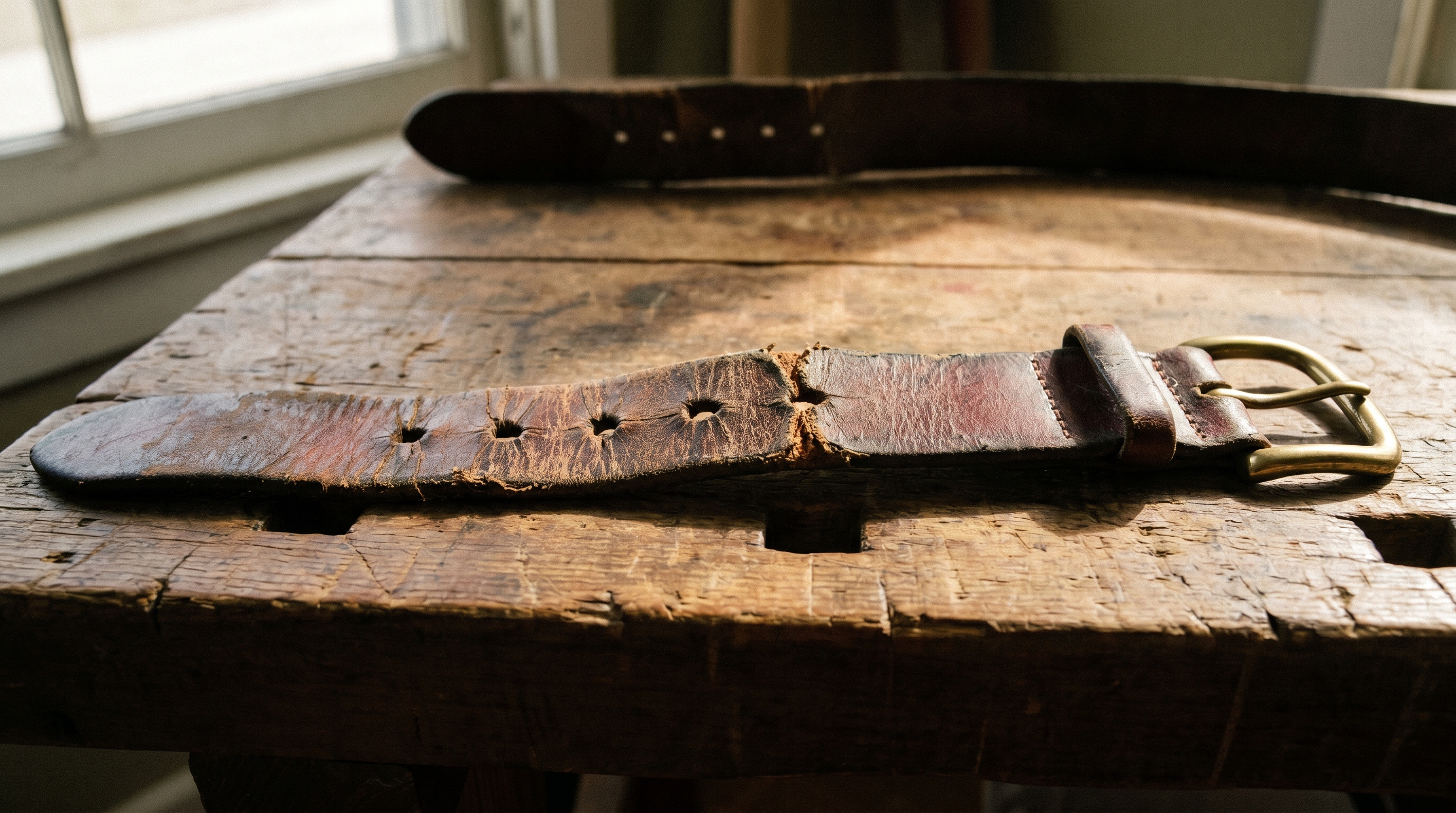
Most belts fail the same way. Not dramatically. Not all at once. They fail in the small, daily way of a thing that was never quite right to begin with. The leather creases between the holes you use most. The buckle tongue bends. You rotate between hole three and hole four depending on whether you've eaten lunch yet, and neither one sits exactly right. The belt works, technically. It just never fits.
This is a geometry problem dressed up as a wardrobe problem. A standard belt punches five to seven holes spaced roughly an inch apart. Your waist, on any given day, does not care about those intervals. Waistlines shift with the season, with the cut of a trouser, with whether a shirt is tucked. The hole system demands you conform to it. That's the wrong direction.
Why no one fixed this sooner
Belts have operated on the same mechanical logic for centuries because, for most of that time, the alternative was worse. Early ratchet mechanisms were thick, plasticky, and the buckles looked like they belonged on luggage. The trade-off wasn't worth it. So the notch persisted, and everyone quietly accepted a fit that was approximate rather than exact.
The mechanism that changed the equation is a micro-toothed track cut along the underside of the belt strap. A small pawl inside the buckle engages those teeth and locks at any point along the track, not at predetermined holes. The result is continuous adjustment across the full length of the belt. You set it where it feels right. It holds. When you want to release it, one press on the buckle face disengages the pawl cleanly. No wrestling. No working the tongue free from a tight hole at the end of a long day.
The version we settled on is a ratchet leather belt built from heavy-duty dark leather that reads as dressed or casual without announcing itself either way. The strap ships long enough to cover a 28 to 48 inch waist and trims down with standard scissors, which removes sizing as a variable entirely. The automatic buckle has the kind of clean release that only registers as a detail once you've used a buckle that doesn't have it. It arrives in a gift box, which matters more than it sounds. No extra wrapping. No sourcing tissue paper. Just a considered object presented in a way that reflects the thought behind it.
For the man who rotates through two or three belts that are all slightly wrong, this is the one that makes the others redundant. It works in denim and it works tucked under a blazer. The dark leather patinas well, holds its structure, and doesn't telegraph its age the way lighter leathers do. He'll notice the fit the first time he puts it on and probably won't think about it again, which is the whole point.
A belt that disappears into the day is a small thing. It's also the kind of small thing that compounds. Less friction in the morning. One fewer adjustment mid-afternoon. The difference between getting dressed and getting it right.
Worth sending to someone who deserves a clean upgrade.