
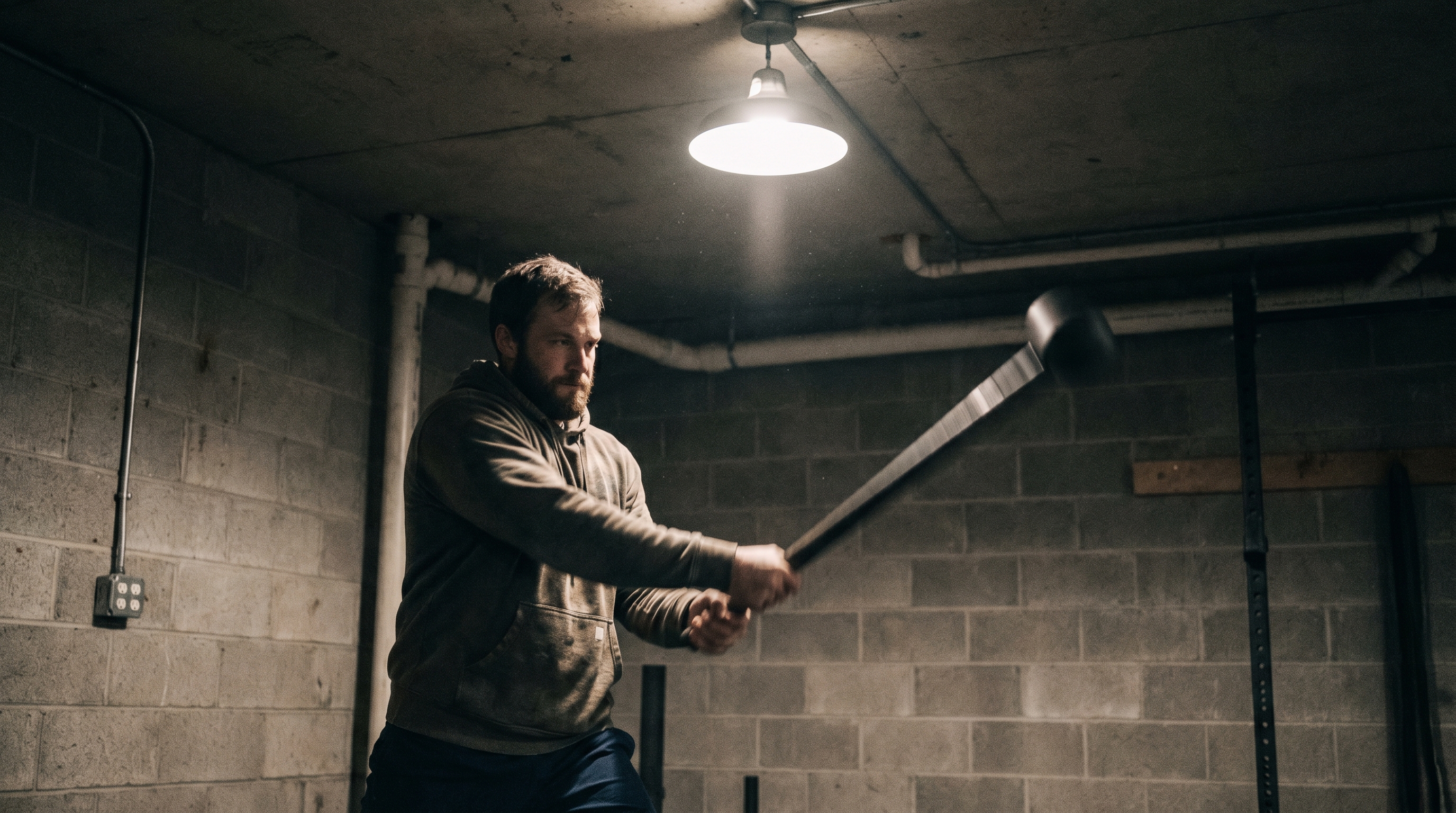
Bilateral, symmetrical loading is the default grammar of most training. A barbell sits evenly across both hands. A pair of dumbbells mirrors itself. The weight is centred, the movement is clean, and the stabilisers, to a degree, get a free pass. That's not an argument against barbells. It's just worth knowing what they're not asking your body to do.
The steel mace asks something different. The mass lives entirely at one end of a long handle, which means your grip, shoulder girdle, rotator cuff, and deep core are constantly negotiating torque rather than simply pushing or pulling a load. The movement patterns, particularly the 360 swing and the 10-to-2, require the body to produce and absorb rotational force through a full arc of motion. That's not a novelty. That's a demand most people have quietly been skipping.
A tool with a longer track record than the gym itself
Mace training traces back at least to ancient Indian wrestling culture, where the gada was a standard conditioning tool for wrestlers building shoulder endurance and grip strength. Persian athletes trained with similar implements. The through-line to modern functional fitness isn't trend-chasing; it's rediscovery. The exercise science now has language for what those practitioners understood by feel: anti-rotation strength, shoulder mobility under load, scapular stability through a moving chain.
What makes it transferable is the carry-over. Rotational strength built through mace swings shows up in sports, in manual labour, in the way someone moves when they're fatigued and their body has to self-correct. It's not isolated hypertrophy. It's the kind of conditioning that makes other training feel more manageable.
The grip component is worth singling out. A long-handled implement with offset mass creates significant leverage at the hand, which means the forearm and grip are working through the entire set, not just at the initiation point. Over time that builds the kind of grip endurance that doesn't show up in a standard deadlift PR but absolutely shows up everywhere else.
The version we settled on
The Steel Mace Bell is solid steel throughout, no rubber filler, no coated tricks to fake a quality feel. The diamond knurl on the handle is cut to actually engage, which matters most in the later reps of a high-volume swing set when a smooth handle would simply let fatigue cheat. The weld is clean. At seven weight increments from 5 lb to 30 lb, it fits both the person building their first real movement practice and the experienced lifter who wants to add rotational work to a programme that's heavy on bilateral loading. Most people starting out find the 10 or 15 lb humbling in the right way. Those with more time under the bar tend to settle on 20 or 25 for swing circuits once the patterns are locked in.
It stores in a corner. It doesn't require a bench, a rack, or a gym membership to be useful.
For someone who trains consistently and applies a little scrutiny to what earns a place in the rotation, this is a considered addition. It fills a specific gap: the work that mirrors and cables and barbells have been collectively ignoring. The first session tends to make that gap obvious pretty fast.
Worth picking up.