
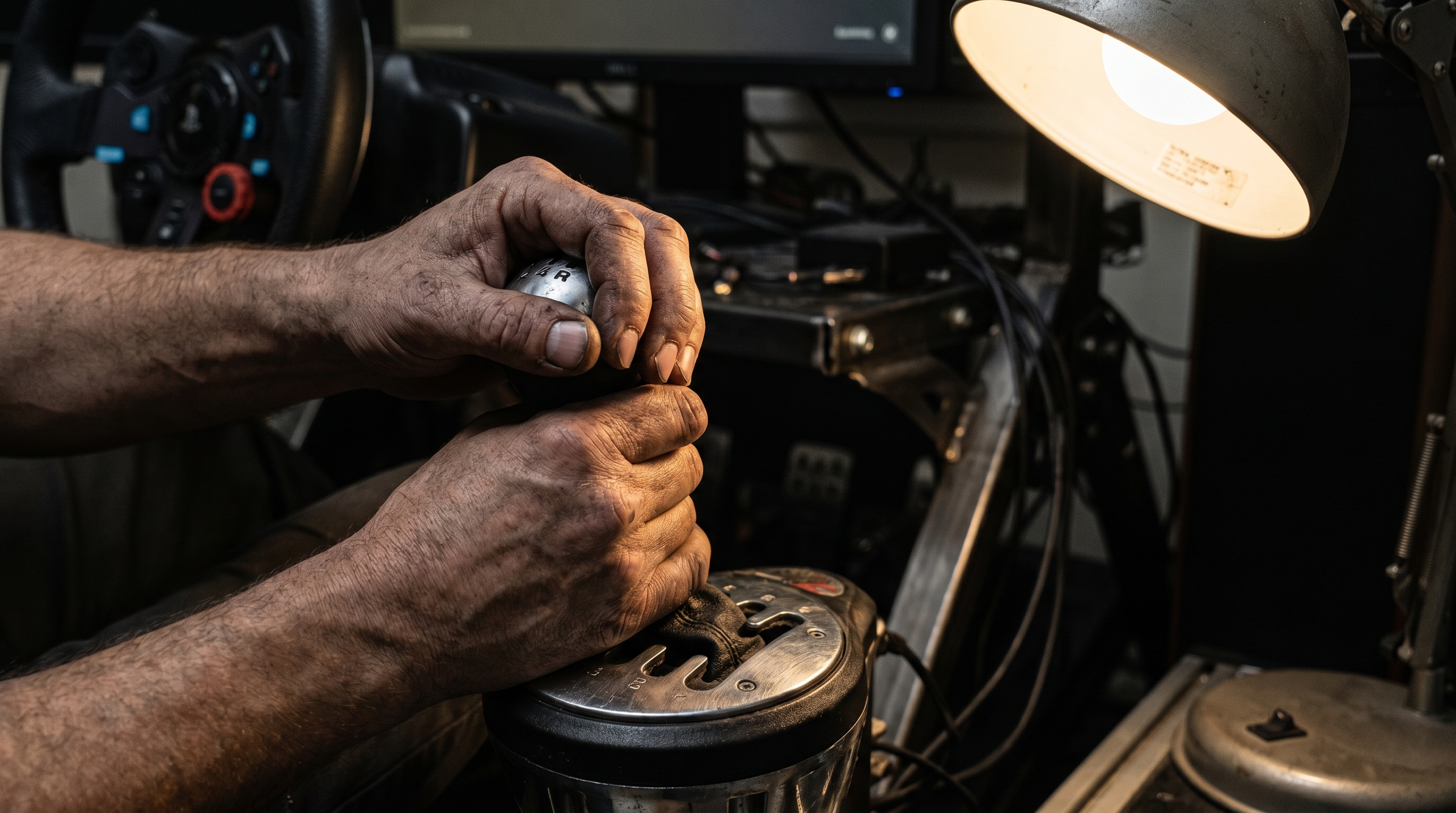
A wheel upgrade is easy to justify. Pedals too. You feel both of them on every single input, and the feedback is immediate. The shifter sits there looking fine, doing its job well enough, and so it stays. For months. Sometimes years.
The problem is that "well enough" in a shifter has a specific feel. A vague gate. A throw that's a little too light, a little too loose, with just enough slop to remind you, every single gear change, that this is still the part you haven't dealt with yet. It doesn't ruin a session. It just sits at the edge of it, like a thread loose on an otherwise clean seam.
What the throw actually tells you
Sim shifters are not all built the same way, and the difference shows up in the gate. On a properly gated H-pattern, each gear position has resistance at the entry and a positive stop at the bottom. You know when you're in gear. On a cheaper unit, the resistance is tuned by feel-testers working from a cost ceiling, not from any real reference point. The result is a throw that feels approximate. Plausible, but not convincing.
Sequential mode compounds this. The snap of a sequential shift in a rally or single-seater context is a very specific mechanical action, a deliberate forward or back with a clean reset. If the unit is doing double duty across both modes without any real engineering behind the swap, one of them always suffers. Usually sequential, because it demands more precision in a shorter travel window.
The other thing that gets overlooked is mode-switching itself. A lot of dual-mode shifters on the market handle the swap in software, which means a driver profile change, a settings menu, or at minimum a reboot. For a racer who moves between disciplines in the same session, that friction is real. Not catastrophic, but real.
The version we settled on
The SIMSONN HS Pro handles H-pattern (6+R) and sequential (7+R) in a single unit, and the mode change is mechanical. No software toggle, no profile switching, no extra hardware sitting in a drawer somewhere. The throw is gated and deliberate in H-pattern, and the sequential action has the kind of resistance that was clearly set by someone who'd used one before. The housing is solid in the way that matters, which is not about weight or visual heft but about what it feels like when you're putting force through it under pressure.
Mounting drops into standard rig profiles without fabrication, which matters because a shifter upgrade shouldn't turn into a fabrication project. Both mode configurations cover the full gear range, so it moves between a road-car build and a rally or formula setup without swapping units or rebuilding a section of the rig.
For a setup that's mostly sorted, this is the part that finishes it. He's already done the work on the wheel, the pedals, the seat position. The shifter is the last variable. Getting it right doesn't change how the rig looks. It changes how it feels to drive, which is the only thing that was ever the point.
Worth handing over.