
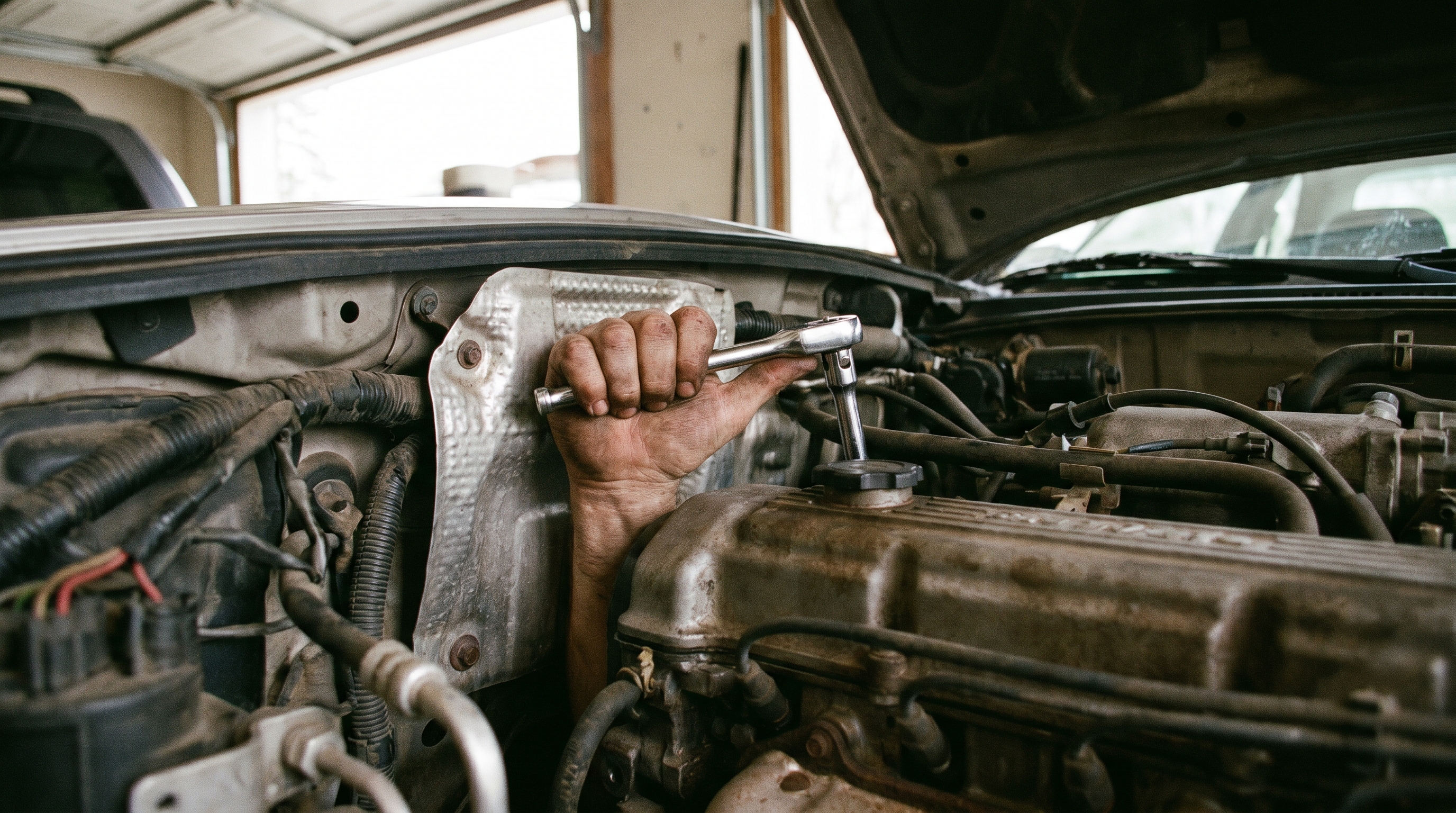
A standard ratchet wrench handles about 80 percent of what most people need it to do. That 80 percent feels fine. The other 20 percent is where the swearing starts.
Tight wheel wells. Cramped engine bays. Fasteners tucked behind a bracket, a hose, a heat shield, or all three at once. The problem isn't the tool's quality, it's the geometry. A straight-body ratchet requires a swing arc to advance the drive, and in confined spaces there is simply no arc available. You get a fraction of a turn per stroke, then you're fishing the head back to starting position with your knuckles against something hot. The job takes four times longer than it should, and the only reason most people put up with it is that they've never worked with a right-angle head long enough to know the difference.
Why the angle changes everything
Right-angle ratchets orient the drive perpendicular to the body of the tool. This means the working head tucks into gaps that would stop a conventional ratchet cold, and the handle stays out in open space where you can actually grip and turn it. The mechanical principle is not new, pneumatic right-angle ratchets have been standard in professional shops for decades, but the air hose and compressor requirement kept them squarely in the professional category. You weren't dragging a compressor out of the corner of the garage for a brake job on a Saturday.
Cordless changed that equation. Lithium-ion batteries are now small enough and powerful enough that a cordless right-angle ratchet is genuinely portable, genuinely capable, and genuinely something a person can own without a compressor and 30 feet of air hose to back it up. The barrier that kept this category in the pro shop dropped, and the tool followed.
The version we settled on runs on a 3/8-inch drive, which is the most practical socket size for the fasteners that show up in everyday car maintenance and home repair. It ships with two 1500mAh lithium-ion batteries and a charger, so if one battery runs low mid-job, there's no waiting. Eight sockets cover the range you'll actually reach for, and the right-angle head is the whole point: it fits where the straight-body tool doesn't, which is exactly the situation that made you want a better ratchet in the first place.
This is not a tool that tries to do everything. It does one specific, frustrating thing unusually well, and it does it fast enough that the job you've been putting off because the access is terrible becomes the job you knock out before lunch.
For someone who spends real time under a car, or who handles their own home maintenance and has run into that maddening "almost reachable" fastener more than once, this earns its spot in the kit immediately. He'll find a use for it the same week it arrives, and probably the week after that too.
Worth handing over.