
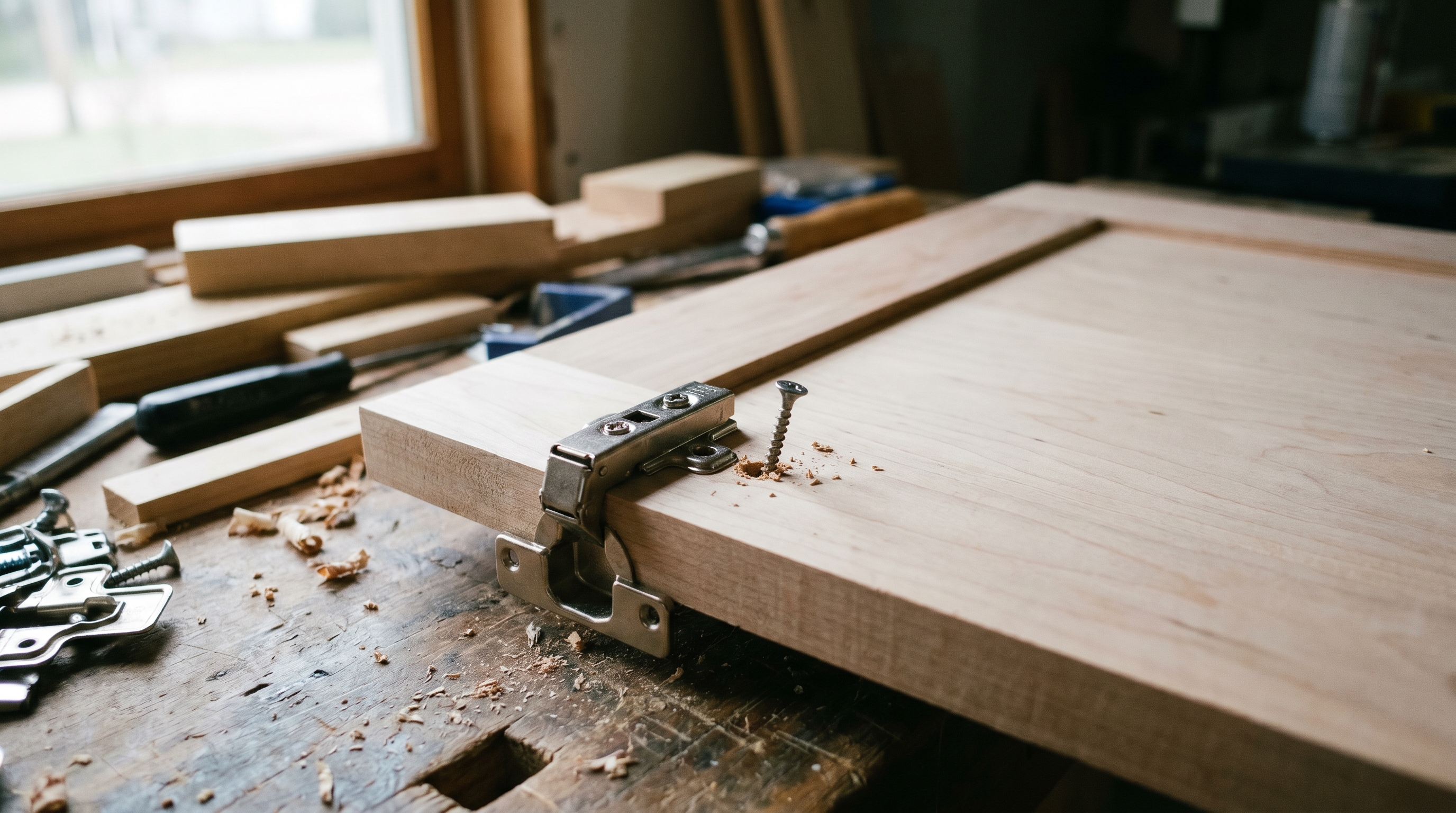
There is a specific kind of frustration that doesn't announce itself until it's too late. You drive the last screw on a cabinet hinge, swing the door closed, and it sits three degrees off. Not broken. Not catastrophic. Just wrong, and permanently so, because the pilot hole is already there and it's already in the wrong place.
The instinct is to blame the hand. Steadier next time, you think. But the hand isn't the problem. The process is.
What freehand drilling actually costs you
When you mark a pilot hole by eye, you're stacking tolerances. The pencil mark, the bit finding its seat, the angle of entry, the grain of the wood pushing back slightly, all of it compounds. On a straightforward through-hole, a millimeter of drift is nothing. On a hinge cup, where the screw position determines whether a door closes flush against a frame, it's the whole job.
Experienced woodworkers and finish carpenters have known this for decades. The VIX-style self-centering bit was developed specifically to collapse that stack of variables down to one: drop the bit into the recess, let the bevel geometry find center, drill. The spring-loaded collar contacts the countersunk cup of the hinge, the beveled guide seats itself concentrically, and the bit doesn't move laterally. Physics does the alignment work that your eye was never reliable enough to do alone.
It's not a trick. It's the correct tool for the task, applied consistently.
Why most tool kits stop short
The self-centering bit concept isn't new, but most versions are sold as single bits, often sized for one hinge type, with no supporting infrastructure around them. You end up with a specialty tool that covers one use case and lives in a drawer corner, half-forgotten.
The more useful version of this is a coordinated set built around the same hex shank ecosystem you already use. Interchangeable bits, a magnetic holder, depth stops so you're not guessing how deep to go on a plug cut, countersink bits for the flush-screw work that comes before and after the hinge goes on. A kit that covers the full sequence of a cabinet or hardware install, not just one step of it.
The version we settled on is the Self-Centering Drill Bit Set. Three spring-loaded VIX-style bits with knurled locking collars for fast head swaps, three replacement HSS bits, a magnetic 1/4-inch hex holder, six driver bits, and two hex keys, all in a compact case. The 22-piece configuration adds five countersink bits, two wood plug cutters, and two depth stop rings for anyone building out a more complete kit. Steel and brass construction throughout. Standard 1/4-inch hex shank, so it runs on whatever drill or driver he already owns without an adapter conversation.
Who actually reaches for this
The person this is built for isn't necessarily a professional. He's someone who installs things himself because he cares how they turn out. Kitchen cabinet hardware, bathroom vanity hinges, built-in shelving, a drawer pull that needs to sit perfectly parallel. The kind of work where close enough is visibly not good enough, and where doing it twice is worse than taking the extra thirty seconds to do it right the first time.
It fits a toolbox drawer without reorganizing the whole thing. It covers enough of the install sequence that you're not switching kits mid-job. And once you've used a self-centering bit on a hinge install, going back to eyeballing feels like a deliberate choice to make things harder.
Worth building with.