
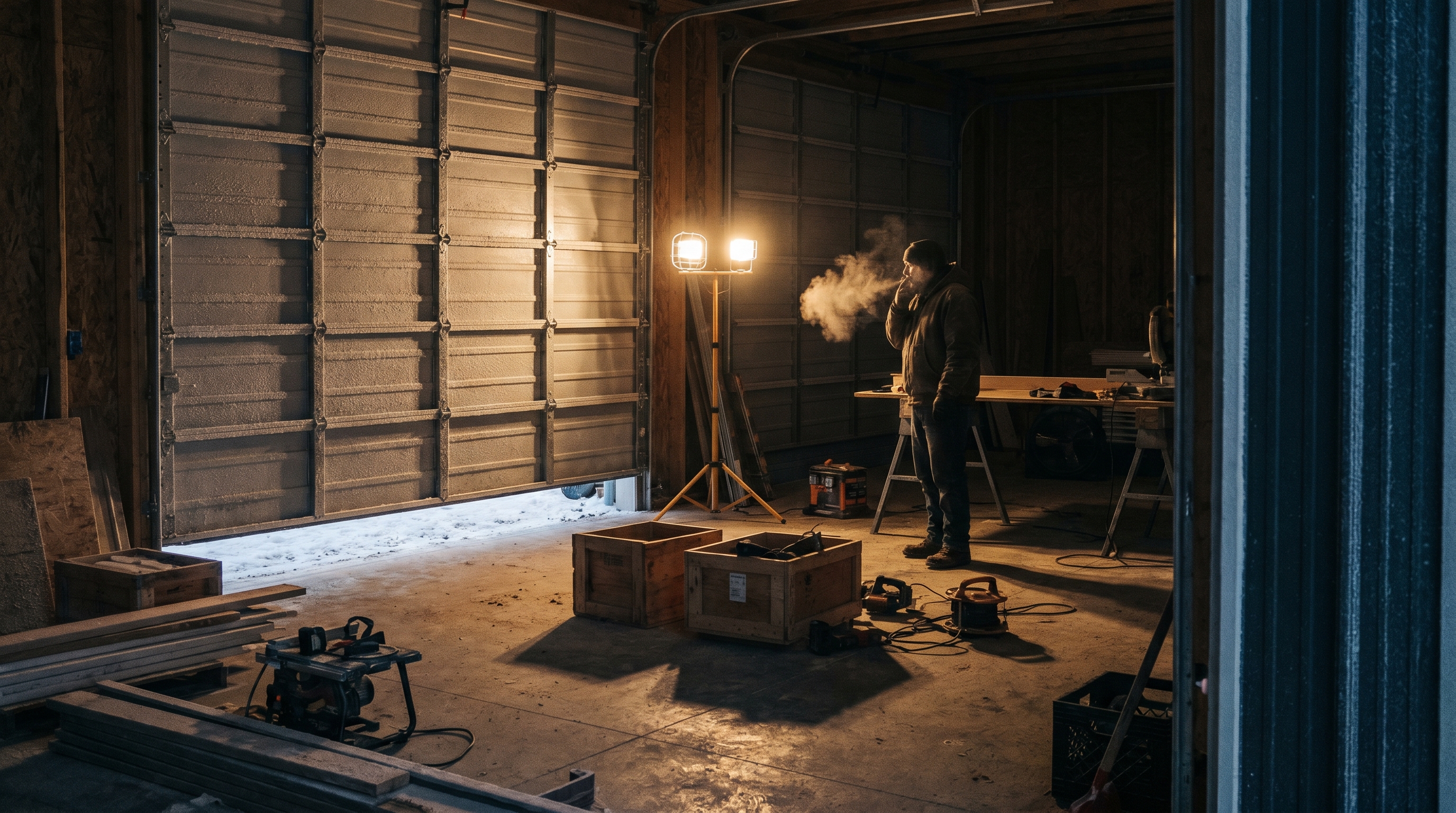
The walls got insulated. The attic got insulated. The crawl space probably got a guy in a Tyvek suit at some point. And then there's the garage door: eight or sixteen square feet of unbroken metal panel, sitting between your heated house and the outdoors, doing essentially nothing to slow the transfer of temperature in either direction.
It's the kind of thing you stop noticing because it was always that way. The garage is cold. The garage is hot. That's just how garages are.
It isn't, actually.
What's happening inside that door
A standard steel garage door has an R-value somewhere between 0 and 2. A finished interior wall typically runs R-13 to R-19. That gap is doing real damage, not just to the ambient temperature of the space, but to everything stored inside it. Lithium batteries lose capacity when they cycle through hard cold. Paint freezes, separates, and won't re-emulsify properly. Workshop tools collect condensation when the temperature swings across the dew point. The car itself starts harder in cold garages because the oil has thickened overnight.
Beyond the equipment, there's the energy bill. A garage attached to a heated home is a thermal bridge. The cold air pooling in an uninsulated garage pulls heat out of the adjacent rooms continuously, and your HVAC system compensates without you ever noticing the load.
The standard fix for most people is to ignore it, because the alternative sounds like a project: sourcing rigid foam board, cutting it to fit each door panel without crushing it into crumbs, finding adhesive that will hold through seasons of expansion and contraction. That's a Saturday with a utility knife and a fair amount of swearing.
Closed-cell foam is the right material here
Not all insulation performs the same in a garage door application. Fiberglass batts won't survive the compression and vibration of a door that opens and closes hundreds of times a year. Open-cell foam holds moisture. Closed-cell foam is dense, rigid, moisture-resistant, and it adds structural stiffness to the door panel itself, which has the side effect of damping road and wind noise from outside. The physics are straightforward: you're adding mass and a thermal break to a panel that currently has neither.
The practical result is a garage that runs 10 to 15 degrees warmer in winter, measurably cooler in summer, and noticeably quieter year-round. For a workshop, that means a usable space for more of the year. For a home gym, it means you're not training in a refrigerator from November through March.
The version we settled on is the BEEST Garage Door Insulation Kit, because it removes every friction point that turns this into an all-day ordeal. The panels come pre-cut to 24 by 48 inches with a clean white vinyl face. There's no measuring, no scoring foam on the driveway, no guessing whether a panel is square. The adhesive tape included, BEEST-Lock, is formulated specifically for garage environments, meaning it holds through summer heat, hard freezes, and the humidity that comes with both. A GripReach squeegee and Quick-Snip cutter are in the box. The only thing that needs to come from elsewhere is about an hour.
Single-door and double-door configurations cover the common sizes: 8 panels with 100 feet of tape for doors up to 8 feet wide, 16 panels with 200 feet for double doors up to 16 feet wide. Both are backed by a 3-year extended warranty when registered within 30 days.
For someone who runs tools in the garage through winter, stores anything temperature-sensitive, or just finds the attached bedroom noticeably cold on the shared wall, this is the fix that was always worth doing. It's also a straightforward thing to hand to someone who has everything he needs except a garage that actually works.
Worth the afternoon.