
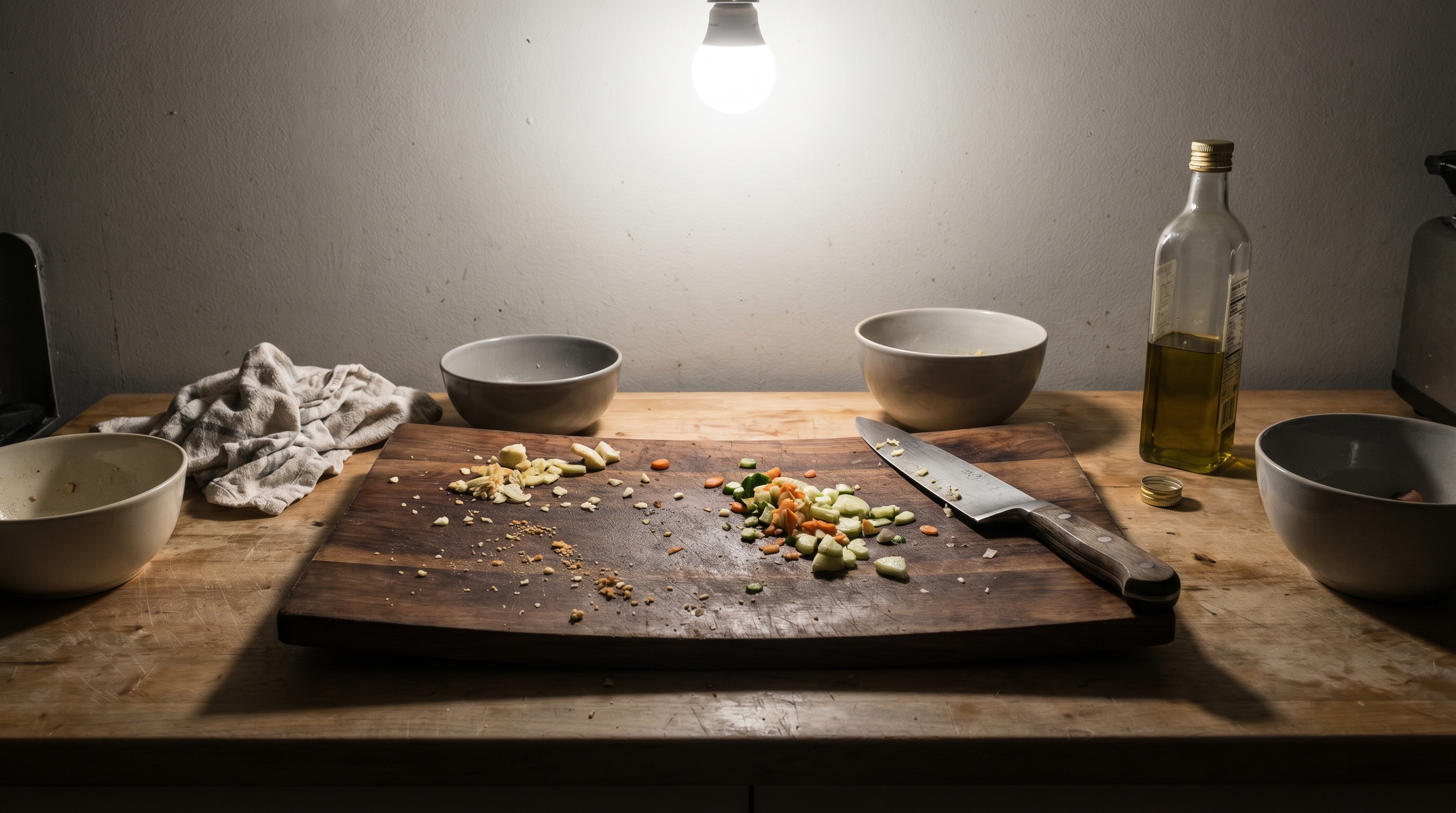
The cutting board is probably the most-touched surface in the kitchen. It's also the one that gets the least consideration at the point of purchase. Most men grab whatever's on the shelf, something wood-toned and vaguely rustic, or a set of plastic ones in three colors they'll never actually sort by food type. Then they use it daily for two years without thinking about it, until it starts sliding across the counter mid-chop, or splits along a seam, or develops a smell no amount of scrubbing removes.
That smell is the real issue with wood. The grain is the problem. Bacteria don't sit on top of wood; they move into it, along the microscopic channels that give wood its texture. A proper wash gets the surface. The interior is another matter. The FDA has been clear on this for decades: porous surfaces in food prep environments are a contamination risk. The cutting board that looks clean after a rinse is not necessarily the cutting board that is clean. Plenty of home cooks know this and just live with the low-level anxiety of it.
Plastic solves the porosity problem on paper, but the surface degrades. Those shallow knife grooves that appear after a few months? Each one is a harbor. Consumer-grade plastic boards also flex and migrate during use, especially on smooth counters. You've felt this: you're pressing into something and the board shifts. It's a minor annoyance until it isn't.
What the material actually changes
Stainless steel has been the workhorse of professional kitchen prep surfaces for a reason that has nothing to do with aesthetics. It's non-porous at any scale a knife reaches. There's no grain, no absorption, no reason for residue to survive a wipe-down. It doesn't react to acidic foods, doesn't take on odors, and doesn't swell or contract with humidity. A stainless board used hard every day looks and performs the same in year five as it did in week one. That kind of material stability is genuinely rare in kitchen equipment at this price point.
The version we settled on is a large-format stainless board built with a non-slip base that keeps it seated during real cooking, not just when you're slicing strawberries. The surface handles everything: vegetables, raw meat, bread, fish, without any of the cross-contamination paranoia that comes with a board that absorbs. Wipe it down or run it under water. That's the entire maintenance protocol.
It looks clean on the counter between uses because it is clean. There's no grain pattern slowly darkening, no edge splitting, no oil treatment required to keep it from cracking. It just sits there, flat and ready, which turns out to be more than most boards manage.
The kind of person who'd get the most out of this cooks four or five nights a week and has already upgraded most of the tools around this one. Good knife, decent pan, and then this slightly embarrassing plastic board that's been there since the apartment before last. This fills that gap without ceremony. It's not a collector's item or a conversation piece. It's the board that stays put while he's actually working, cleans up in seconds, and never needs a second thought.
Worth keeping on the counter permanently.