
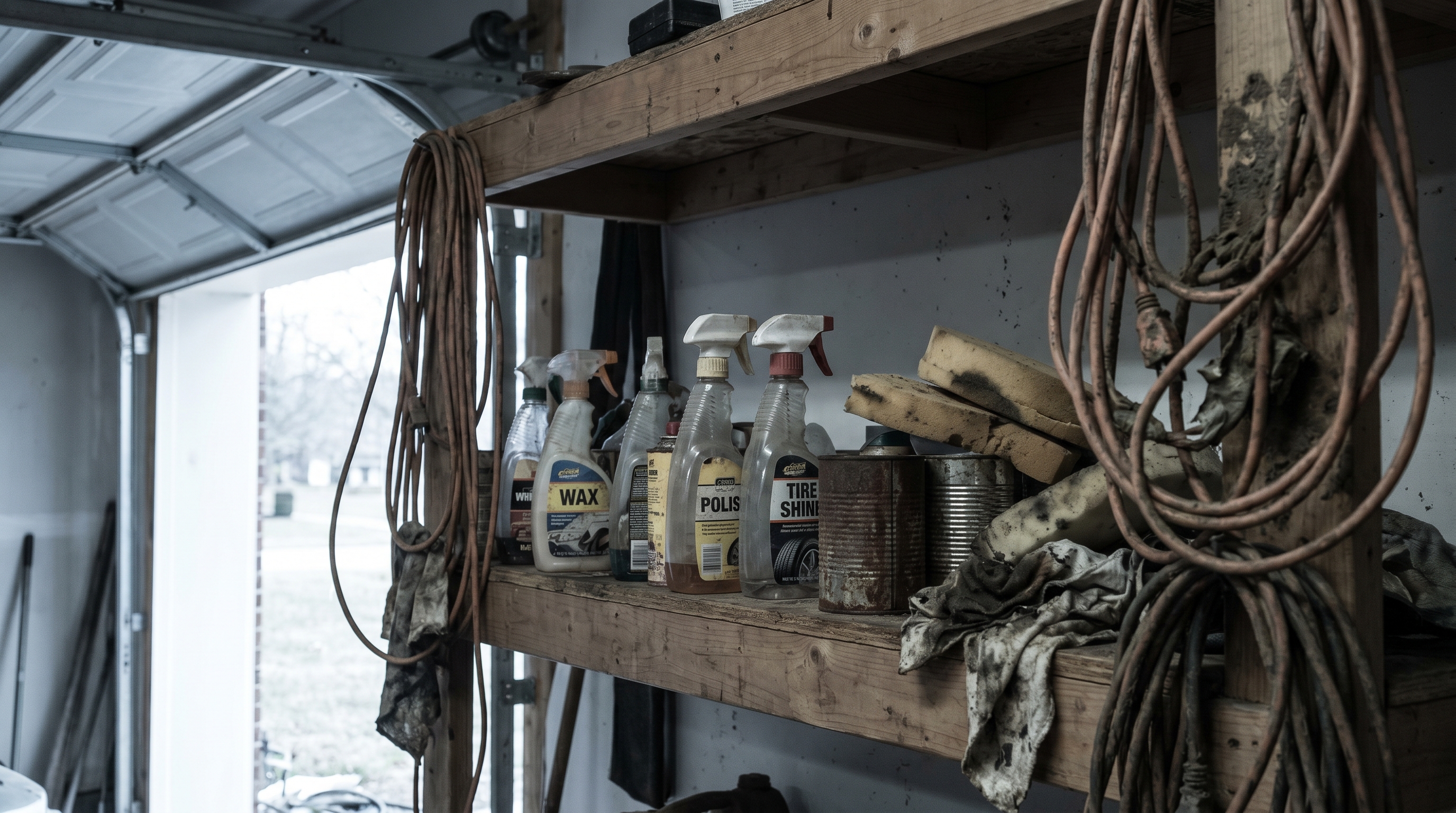
There's a drawer in most garages, sometimes a shelf, sometimes a milk crate, full of car-care products that made sense to buy at the time. A spray wax. A separate polish. A foam applicator that came with something. A microfiber that's seen better days. A sanding compound that's mostly dried out. The collection grows, the car stays average-looking, and the whole system collapses under its own friction.
The friction isn't laziness. It's the setup cost. Hunting for the right product, finding the right pad, working it in by hand, realizing you need an extension cord for the corded buffer you bought three years ago and haven't touched since. Detailing your own car should take an afternoon. Instead it takes enough pre-work to justify booking a professional and calling it a day.
Why hand-application keeps losing
Hand-applied wax isn't ineffective. It's just slower and more inconsistent than it needs to be. A machine applies product with a level of even pressure and speed that a human palm can't replicate over a full panel. The difference shows up in the finish, particularly on darker paint, where swirl marks and uneven sheen catch light in ways that make a car look older than it is.
The other category that tends to get skipped entirely is light paint correction. A fine scratch or a patch of oxidized clear coat doesn't warrant a professional polish job, but it also doesn't buff out with a towel. It sits there. It bothers him every time he walks past the car. The tools to fix it exist, but most of them are either overkill or hard to control without practice.
Cordless changes the calculus, too. The reason most guys reach for a hand applicator isn't preference, it's that running an extension cord across a garage floor to do one door panel feels like more trouble than it's worth. Remove the cord and the job shrinks to something you'd actually start on a Saturday morning.
What we picked, and why
The version we settled on is the Cordless Detailing Buffer. It runs at 12,000 RPM, ships with three pads (one each for polishing, waxing, and sanding), and handles all three jobs without swapping machines. The grip is compact enough to get around door handles and mirrors without your wrist giving out halfway through a quarter panel. The cordless range is wide enough to do the whole car in a driveway without stopping to move a power strip.
It's not a professional rig, and it's priced and designed like it knows that. This is the tool for the guy who wants his car looking right without turning the whole thing into a project. Light scratches, dull clear coat, oil film on the windshield glass, uneven wax from the last hand-application attempt: it handles the actual list of things that tend to pile up between proper details.
The results are noticeably better than anything applied by hand, and the gap between "I should do this" and "I'm doing this" shrinks considerably when the whole setup takes about forty-five seconds.
For anyone looking for a practical gift that won't sit unopened, it ships ready to use. No extra pads to source, no calibration, no learning curve steep enough to put someone off. He picks it up, figures it out in one pass, and it earns a permanent spot in the garage rather than the drawer.
Worth handing over.