
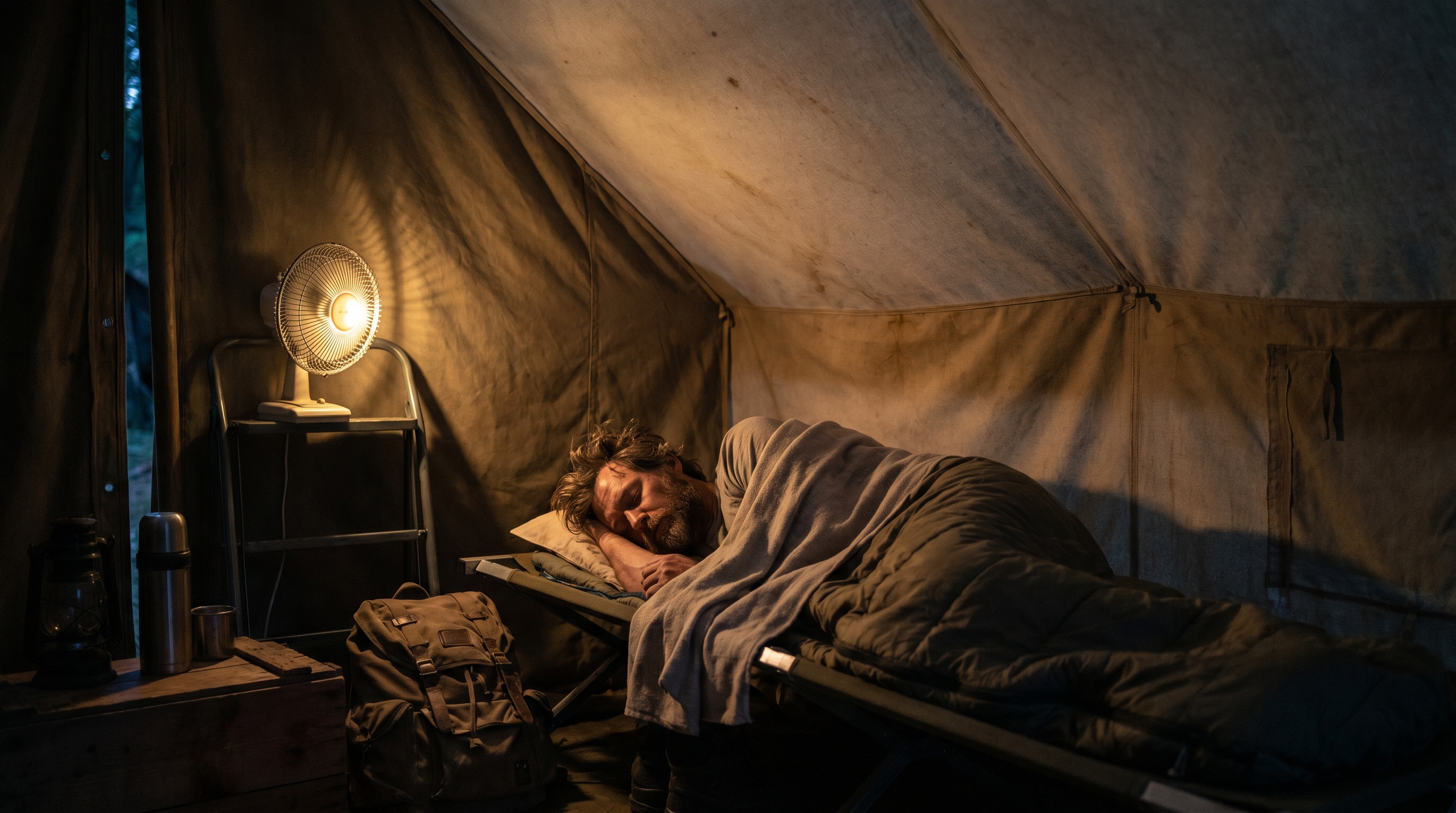
Heat is the thing most people solve wrong before a camping trip. They pack light, they get the tent right, they obsess over the sleeping bag rating, and then they wake up at 2am in a sweat because the cheap clip fan they threw in at the last minute died somewhere around midnight. The battery was always the weak point. It just waited until the worst moment to prove it.
This is a more common failure than it should be. Most compact camping fans ship with batteries sized for the spec sheet, not for a full night in a closed tent in August. Four to six hours is the honest ceiling on most of them. Which means if you fall asleep at 10pm and wake up at 6am, the math doesn't work. You're either running it on low and barely feeling it, or you're waking up in still, warm air wondering why you bothered.
The battery problem is also a light problem and a power problem
Here's the thing that rarely gets discussed: when you're two days from the nearest outlet, every piece of gear that only does one job is a liability. A fan that can't charge your phone is taking up space a power bank could occupy. A power bank that can't light your tent is taking up space a lantern could occupy. Most kits carry all three separately. Some of the time, two of them are dead.
The more useful question isn't "how good is this fan" but "how much can this one object actually cover." Once you start thinking that way, a lot of single-function gear starts looking like a packing problem you've been ignoring.
The version we settled on for the shop is the Rechargeable Camp Fan. The 20,000mAh battery runs up to 12 hours on low, that's a full night without any management. Four wind speeds and a 270-degree vertical pivot mean he can aim airflow across a tent, a truck cab, or a desk without fighting the stand. The built-in USB output charges a phone or tablet, which is the detail that makes it pull genuine power-bank duty when he's off-grid for a few days. The four corner LED lights cover reading and ambient use, with three brightness settings calibrated low enough to be usable at 2am without torching anyone's night vision. A wireless remote handles all of it, fan speed, light level, the 1-to-8-hour timer, without requiring him to move. That's not a luxury. That's just not having to get up.
It hangs from a tent loop on the included hook, sits flat on any surface via the handle, and packs small enough to drop into a day bag without a second thought.
For the person who spends any real time outdoors, car camping, overlanding, a long weekend at a site with no hookups, this is the kind of object that earns its place on the first trip and never really leaves the kit after that. It also makes sense as something to hand over to someone who camps well but gears up practically. He'll notice it on day one and know exactly where it earned its spot.
Worth packing. Worth passing on.