
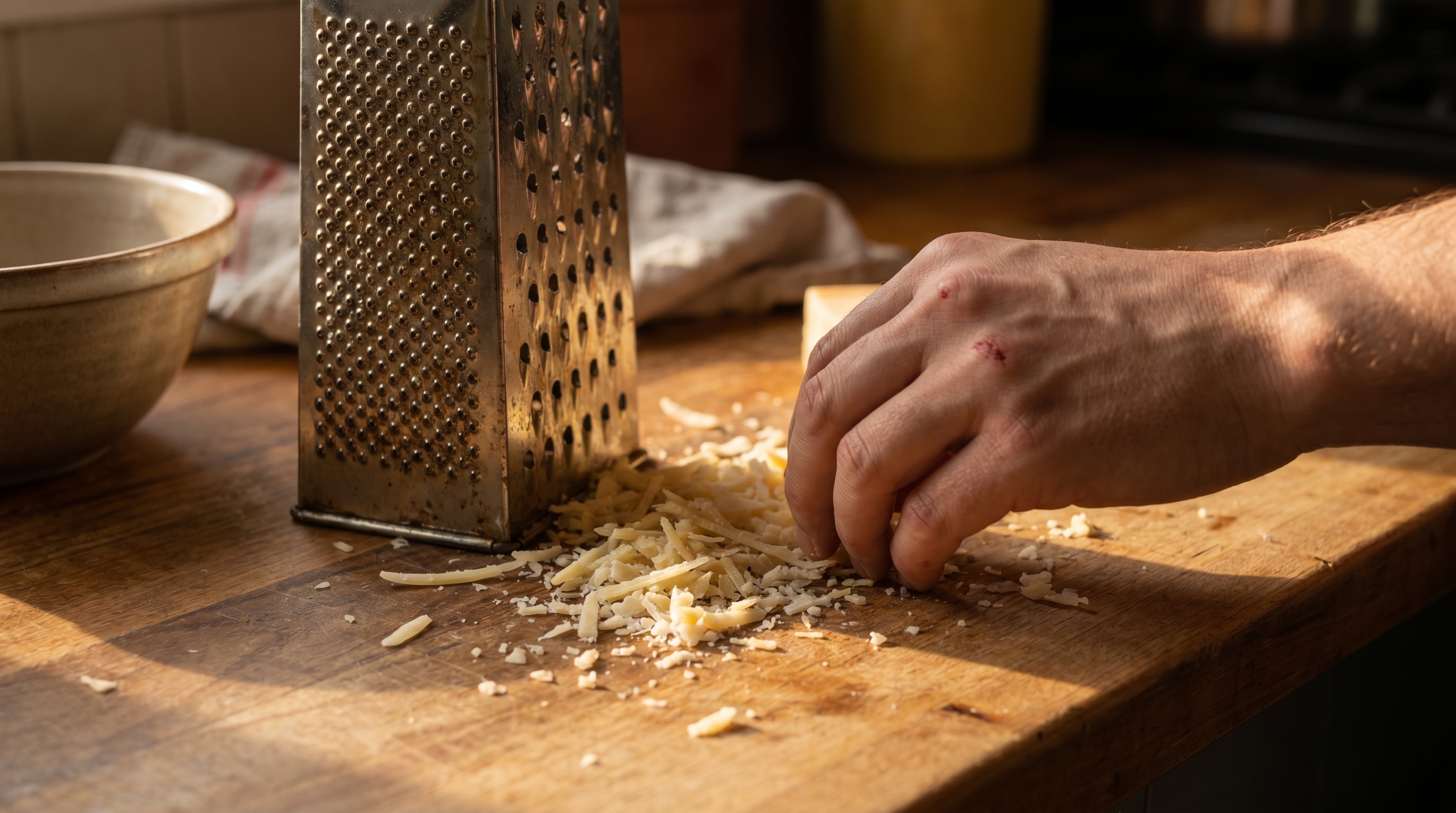
The average box grater sits in a drawer for three weeks between uses. When it finally comes out, it shreds cheese reasonably well, shreds knuckle skin occasionally, and leaves a fine dusting of whatever you were grating across a six-inch radius of counter. Then it goes back in the drawer. This cycle repeats until someone quietly replaces it with an identical box grater and the whole thing starts over.
The problem isn't the grater exactly. It's the format. Flat-against-flat grating is inherently inefficient: you're pushing food into a fixed surface with no mechanical advantage, relying entirely on downward pressure and friction. The faster you go, the messier it gets. The slower you go, the longer it takes. There's no configuration of that motion that doesn't eventually involve a minor injury or a dispersal event.
What a crank actually changes
Rotary graters have been around long enough that they're not a novelty, but they've never quite displaced the box grater as the default. That's partly inertia and partly the fact that early versions were fussy to clean and prone to jamming on anything harder than soft cheese. The mechanics are sound, though. A drum that turns against a stationary blade handles the shearing work more consistently than a back-and-forth drag, and the enclosed chamber means the output goes where you want it, not sideways across the board.
The suction base is what makes the modern version genuinely practical. Both hands free means one steadies the food, one turns the crank, and nothing is sliding around on the counter. It sounds minor until you've tried to grate a block of Parmesan with one hand pinning a grater and the other doing the actual work. That particular piece of kitchen choreography should have been retired years ago.
The transparent drum matters more than it sounds, too. Grating by feel over a pan is guesswork. Seeing exactly how much has accumulated before you dump it in is the kind of small precision that separates a dish that's well-seasoned from one that's aggressively over-cheesed.
The version we settled on for the shop handles the full range: hard cheeses, soft cheeses, chocolate, nuts, vegetables, three interchangeable stainless steel blades for different textures. The drum and blades detach and rinse clean in under a minute. It stores compactly. It doesn't announce itself on the counter, but it doesn't disappear into a drawer either.
For someone who cooks three or four nights a week, this is the kind of tool that quietly raises the baseline of the whole kitchen. He won't think about it as a significant upgrade. He'll just notice that grating Gruyere for a gratin takes two minutes instead of eight, and that both his knuckles survived the process intact. That's the kind of result that turns a tool into a fixture.
Worth keeping out.